
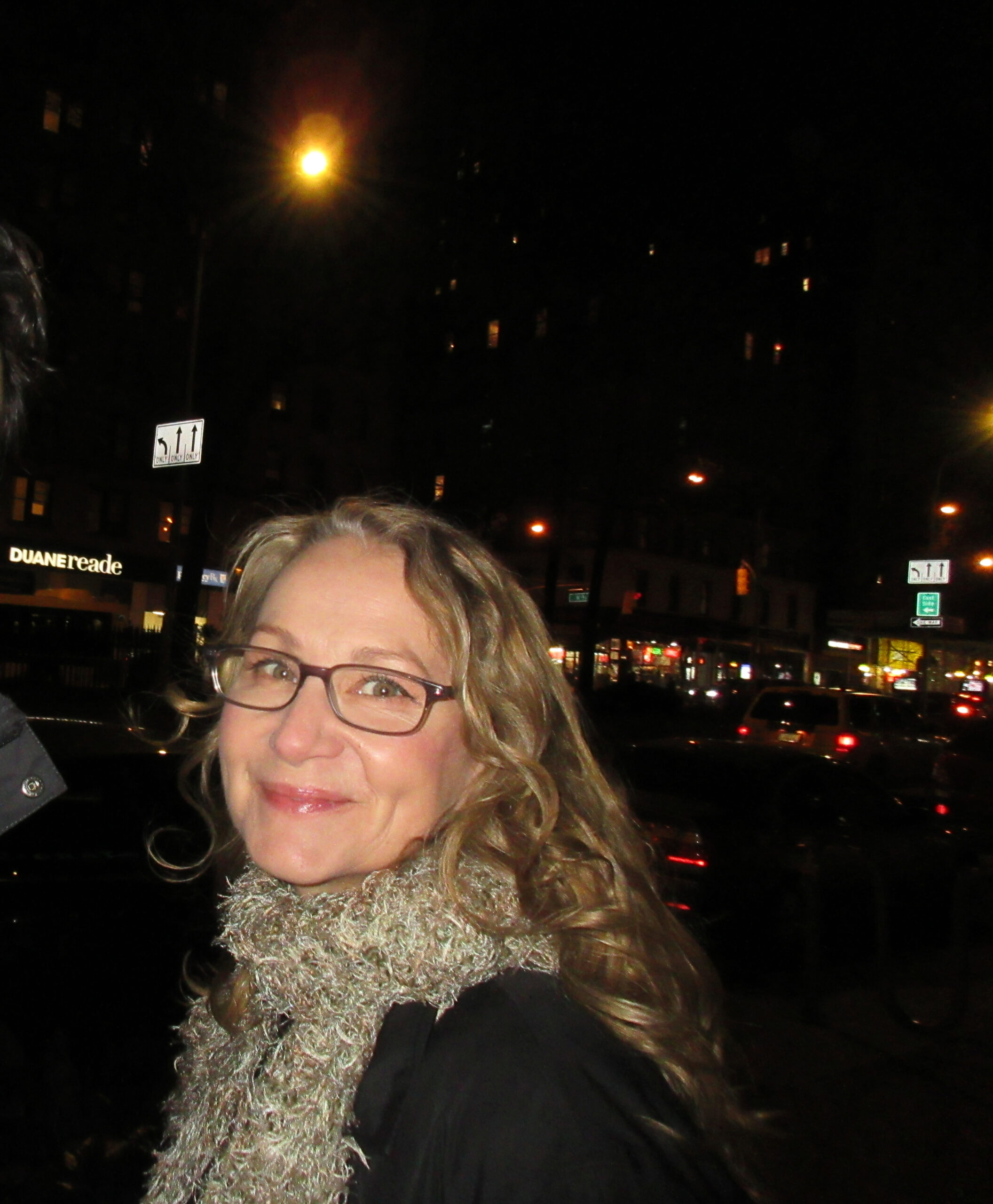
Joan Osborne grew up in Anchorage, Kentucky, a small town a few miles east of Louisville, one of six children in a Catholic family that let its kids run loose in the surrounding woods. She left for New York City at nineteen to study filmmaking, and never expected to become a singer.
An accidental night out at a Greenwich Village blues bar changed the direction of her life. Within a decade she had signed a major-label deal, and in 1995 her song “One of Us” — a plainspoken meditation on God and an ordinary stranger — became a worldwide hit, earning Grammy nominations for Record of the Year and Song of the Year.
Osborne has since sung lead for the surviving members of the Grateful Dead, toured with Motown’s Funk Brothers, and released more than a dozen solo albums spanning blues, soul, gospel, and rock. She has lived in Brooklyn for decades, but has said the freedom of her small-town Kentucky childhood still shapes how she hears music and moves through the world.
A Small Town East of Louisville
Osborne was born July 8, 1962, and raised in Anchorage, a small, wooded suburb east of Louisville known for its horse farms and one-room train depot. She has described it as a place with almost no boundaries for a child. In a 2012 interview, she recalled a hometown where doors stayed unlocked and neighbors watched out for each other’s kids without being asked.
“It was a pretty idyllic way to grow up. I lived in a town where everybody knew everybody, and nobody locked their doors at night. I have five brothers and sisters, and we used to just go running around in the woods, building forts and staying out all day. In the summertime, we’d leave in the morning and come back in time for supper and have adventures.”
— Joan Osborne, in a 2012 interview
That freedom, she has said, is hard to replicate while raising her own daughter in New York City, where she can’t simply open the door and let a child run loose until suppertime. But she has also said she’s grateful for the trade-off, even if it cost some of the wildness she remembers from Kentucky.
Six Kids, the Woods, and a Question of Faith
Osborne was raised Catholic, and by her own account took the rituals of the Church seriously as a small child — seriously enough that she wanted to become a priest. Around age nine or ten, she learned the priesthood was closed to girls, a discovery that unsettled her.
“When I was really small, I wanted to be a priest. Then, I found out I could not, in fact, be a priest because girls were not allowed to grow up to be priests. I felt like this was very unfair, and I think that was my first moment of questioning what it was all about and what the institution was all about.”
— Joan Osborne, in a 2012 interview
She has said she stopped practicing Catholicism around that age, though she still describes herself as someone who believes in a higher power and a “positive force in the universe.” That early, unresolved argument with organized religion would resurface years later in one of the most recognizable songs of her career.
Leaving Anchorage for New York
At nineteen, Osborne left Kentucky for New York City to study filmmaking at New York University, planning on a career as a documentary filmmaker. She had barely sung in public before. Kentucky, she has said, was a place she “didn’t really do music” — the discovery came only after she arrived in Manhattan and stumbled into the blues clubs then thriving downtown.

She has said the contrast between Anchorage and New York was total: a town with no locked doors traded for a city of strangers on every corner, overheard conversations, and unfamiliar languages. She found the density of New York exhilarating rather than isolating, and has said the city has supplied her with material, and inspiration, for three decades since.
A Dare in a Blues Bar
The turning point came almost by accident. Out with a friend one night, Osborne ended up at a blues bar in Manhattan after the band had already finished its set. A piano player stayed behind, playing for himself and a handful of stragglers at the bar.
“We went to this bar, which happened to be a blues bar. The band had finished playing, but there was a piano player who was still there playing for himself and a handful of people who were still at the bar. My friend dared me to go up and sing a song with this piano player and said he’d buy the drinks if I did. So, being the broke college student that I was, I was like, ‘Sure.’”
— Joan Osborne, in a 2012 interview
She sang a Billie Holiday song. The piano player invited her back for the bar’s open mic night the following Tuesday. She kept returning, week after week, and started meeting the musicians playing New York’s clubs — a scene she has described as “very much blues music based” and “really vibrant.” Within a few years she had formed her own band and was performing alongside acts like the Spin Doctors and Blues Traveler.
Relish, and a Song That Asked About God
By the early 1990s, Osborne had founded her own label, Womanly Hips, to release a live blues record, Soul Show: Live at Delta 88, before signing with Mercury Records. Her 1995 major-label debut, Relish, paired her blues-trained voice with songwriting from a wide circle of collaborators, including Eric Bazilian of the Hooters, who wrote “One of Us.”
The song, which imagines God as “one of us… just a slob like one of us,” became a Top 40 hit in November 1995 and pushed Relish past platinum sales. It also drew both admiration and controversy for the plainness of its questions about faith — an irony not lost on Osborne, who had wrestled with her own break from the Catholic Church as a child in Kentucky. Relish went on to earn nominations for Album, Record, and Song of the Year at the 1996 Grammy Awards.
Motown, the Dead, and a Career Built on Range
Osborne’s career after Relish resisted easy categorization. She produced albums for the gospel-blues duo the Holmes Brothers, appeared in the 2002 documentary Standing in the Shadows of Motown, and toured afterward with the film’s subjects, Motown’s studio musicians the Funk Brothers. In the mid-2000s she joined former members of the Grateful Dead as a touring vocalist, performing with both The Dead and Phil Lesh and Friends.
She has said her early immersion in blues and gospel gave her a shared musical vocabulary with the Funk Brothers and the Dead’s musicians alike, even when the styles looked nothing alike on paper. In a 2019 interview, she described tracing blues and R&B back to gospel, Appalachian country, and jazz as a way of understanding “this longer tradition of people making music in this country.”
Kentucky Still in the Voice
Osborne has lived in New York far longer than she ever lived in Kentucky, and has said Brooklyn is unambiguously home now. But she has continued to describe her Anchorage childhood — the freedom, the woods, the unlocked doors — as a formative contrast to the city she chose.
“I’m grateful to have had that kind of freedom and connection to nature and all the things that were great about growing up in that time and place.”
— Joan Osborne, in a 2012 interview
More than three decades after leaving Anchorage for a filmmaking degree she never finished, Osborne remains one of the few platinum-selling artists to trace a hit about God, faith, and ordinary life directly back to a small town outside Louisville, Kentucky — a place, she has said, that shaped nearly everything that came after.