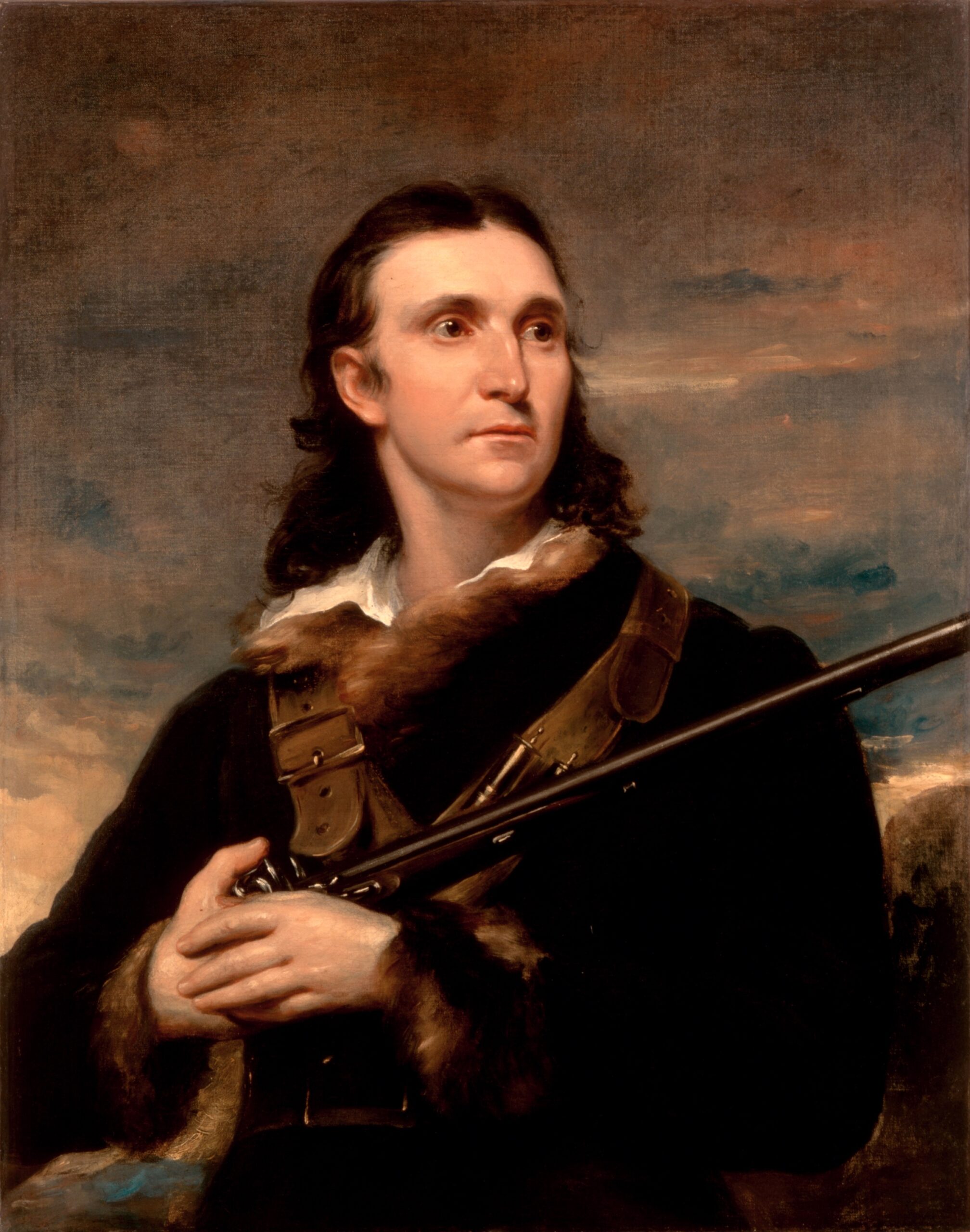
John James Audubon is remembered as the painter who catalogued the birds of a continent, but for several years he was, at least on paper, a Louisville shopkeeper, a partner in a general store on the Ohio River who could not stop wandering into the woods to draw. Louisville never made him rich. It gave him a rival ornithologist who walked in off the street, a store that failed twice, and one of the most famous eyewitness accounts of animal abundance ever written, watched from the road into town.
A Store on the Ohio
Audubon married Lucy Bakewell on April 8, 1808, at her family’s Pennsylvania estate, and the couple left for Kentucky the very next day. He and his business partner, Ferdinand Rozier, had already sold a plantation and invested the proceeds in goods to stock a store. After a rough overland crossing that badly bruised Lucy, the party floated down the Ohio River by flatboat for twelve days before reaching Louisville.
The store the two men opened in Louisville promised well at first, selling dry goods to the planters and merchants settling the growing river town. Audubon and Rozier stocked it with merchandise carried in on regular buying trips to Philadelphia and New York, journeys that took them back through the same forests Audubon could never quite stop watching.
Rozier at the Counter, Audubon in the Woods
Rozier minded the counter and, by Audubon’s own account, grew steadily richer while his partner spent his days hunting and sketching with the planters around Louisville. Audubon lost track of pack horses loaded with goods and cash more than once, distracted by the sight of an unfamiliar warbler along the trail. He was, by his own admission, no kind of merchant at all.
“I shot, I drew, I looked on Nature only, and my days were happy beyond human conception, and beyond this I really cared not.”
— John James Audubon, on his Louisville years
A Rival Calls at the Counting Room
In March 1810, a stranger walked into the Louisville store carrying two heavy volumes under his arm. It was Alexander Wilson, already at work on his own American Ornithology and seeking subscribers to fund it, a man Audubon had never heard of and whose visit he would describe in vivid detail decades later.
“One fair morning I was surprised by the sudden entrance into our counting room at Louisville of Mr. Alexander Wilson, the celebrated author of the American Ornithology, of whose existence I had never until that moment been apprised. … He had two volumes under his arm, and as he approached the table at which I was working, I thought I discovered something like astonishment in his countenance. He, however, immediately proceeded to disclose the object of his visit, which was to procure subscriptions for his work.”
— John James Audubon, on meeting Alexander Wilson in Louisville, 1810
Two Rival Ornithologists
Audubon nearly subscribed to Wilson’s book on the spot, until Rozier interrupted in French, pointing out that Audubon’s own drawings were at least as good. Audubon then showed Wilson his portfolio, and Wilson, astonished that anyone else had assembled such a collection, asked to borrow drawings and to hunt alongside him during his stay in the city.
“We hunted together and obtained birds which he had never before seen; but, reader, I did not subscribe to his work, for, even at that time, my collection was greater than his.”
— John James Audubon
Wilson left Louisville for New Orleans without responding to Audubon’s counter-offer of a correspondence, and his own diary entry on the visit was terse, claiming he had received no civility in the city and seen no new birds there, a claim flatly contradicted by Audubon’s account of their days afield together. The two men, each convinced of his own place in the still-new science of American ornithology, never fully reconciled.
The Great Pigeon Flight of 1813
In the autumn of 1813, riding from his home in Henderson toward Louisville, Audubon witnessed a spectacle of animal abundance that has become one of the most quoted passages in American nature writing: a flock of passenger pigeons so vast it blotted out the midday sun for the entire fifty-five-mile ride.
“I dismounted, seated myself on an eminence, and began to mark with my pencil, making a dot for every flock that passed. In a short time finding the task which I had undertaken impracticable, as the birds poured in in countless multitudes, I rose, and counting the dots then put down, found that 163 had been made in twenty-one minutes. … The air was literally filled with Pigeons; the light of noon-day was obscured as by an eclipse. … Before sunset I reached Louisville, distant from Hardensburgh fifty-five miles. The Pigeons were still passing in undiminished numbers, and continued to do so for three days in succession.”
— John James Audubon, Ornithological Biography, 1831
Bankruptcy and a Walk Back to Louisville
The store in Louisville failed, and Audubon and Rozier moved their remaining goods further down the Ohio to Henderson, and later still to Ste. Genevieve, Missouri, without ever finding commercial success. By 1819, deep in debt and jailed briefly for insolvency, Audubon lost everything he owned to his creditors.
“I parted with every particle of property I had to my creditors, keeping only the clothes I wore on that day, my original drawings, and my gun, and without a dollar in my pocket, walked to Louisville alone.”
— John James Audubon, on his 1819 bankruptcy
He later called it the saddest journey of his life. “The only time in my life,” he wrote, “when the wild turkeys that so often crossed my path, and the thousands of lesser birds that enlivened the woods and the prairies, all looked like enemies, and I turned my eyes from them, as if I could have wished that they had never existed.”
Drawing Portraits to Survive
Ruined but not idle, Audubon turned the drawing skill he had once used only for birds toward paying customers, taking chalk portraits of Louisville and Ohio Valley residents for a few dollars a head. The work came quickly and steadily enough to reestablish his family in a Louisville household within a matter of months.
“As we were straitened to the very utmost, I undertook to draw portraits at the low price of five dollars per head, in black chalk. I drew a few gratis, and succeeded so well that ere many days had elapsed I had an abundance of work.”
— John James Audubon
Even flush with portrait commissions, he could not leave the birds alone, at times abandoning a paying sitting, in his own words, “to represent a little citizen of the feathered tribe.” The habit that had sunk his business in Louisville a decade earlier was, by then, plainly the only career he was ever going to have.
Legacy
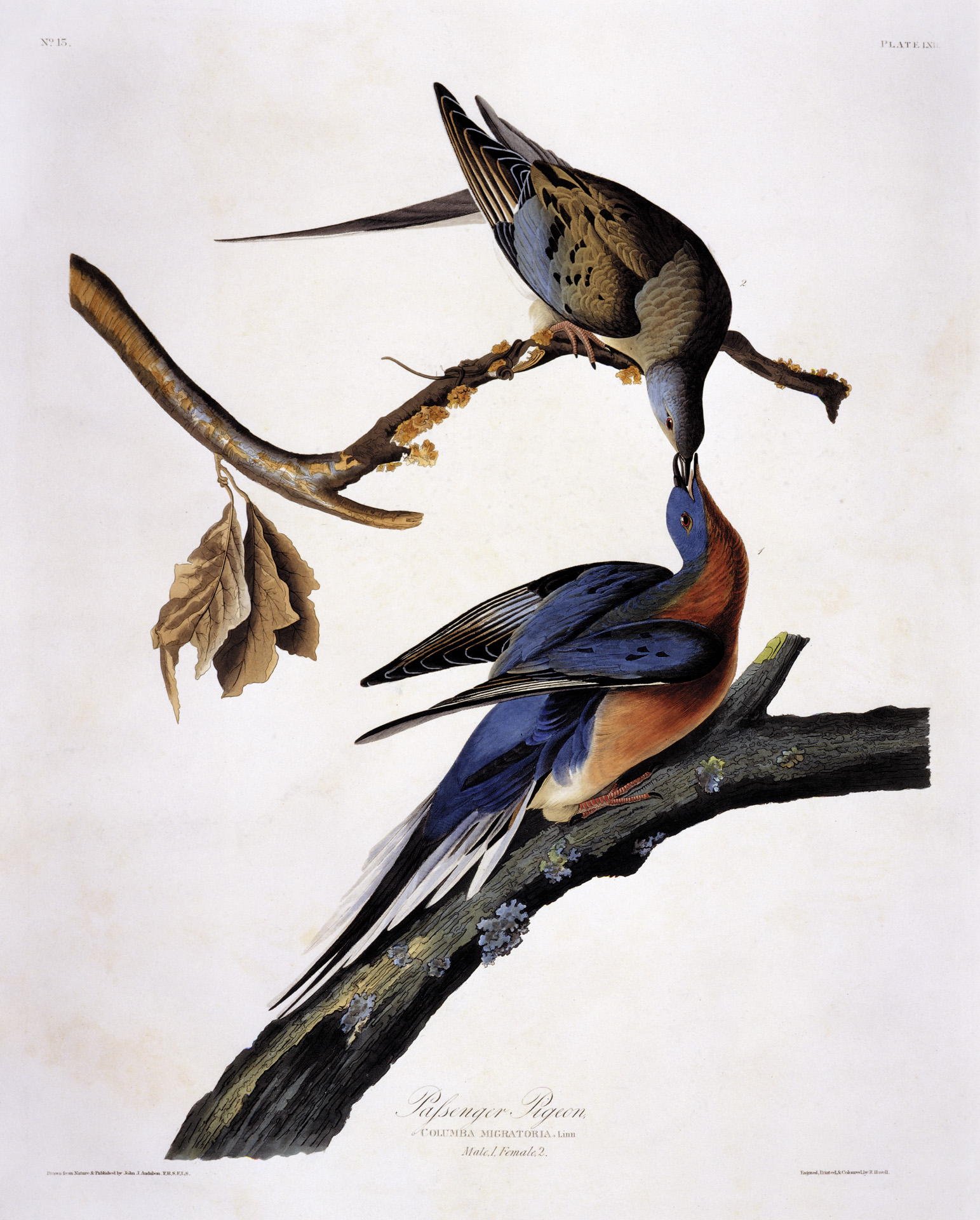
Audubon eventually carried his portfolio to England, where engravers could produce plates large enough to show birds at life size, and The Birds of America was published there in installments between 1827 and 1838. The finished work, now among the most valuable printed books in the world, includes the passenger pigeon he watched darken the sky over the Louisville road, a species hunted to extinction within a century of his ride from Henderson.
Louisville today keeps Audubon’s name on its own map, in the Audubon Park neighborhood and its golf course, while John James Audubon State Park sits downriver in Henderson, where his failed store first sent him. He never found the fortune he chased across the Ohio Valley as a young shopkeeper, but the birds he sketched instead of minding the counter outlasted every ledger he ever kept.
Sources and further reading
- Sources and further reading: “John James Audubon,” by John Burroughs, Project Gutenberg
- “‘…the light of noon-day was obscured as by an eclipse,'” Bath Royal Literary and Scientific Institution
- John James Audubon, Wikipedia
- “John James Audubon, Part 2,” Crystal Bridges Museum of American Art
- Lucy Bakewell Audubon, Wikipedia
More from Louisville
York, an Enslaved Explorer
Another figure whose place in early American frontier history has only recently gotten its due.
Lewis & Clark Expedition
A contemporaneous journey through the same frontier Audubon was cataloguing bird by bird.
Historical Timeline of Louisville
Audubon’s Louisville years, a shopkeeper long before he was a painter, set against the city’s fuller history.