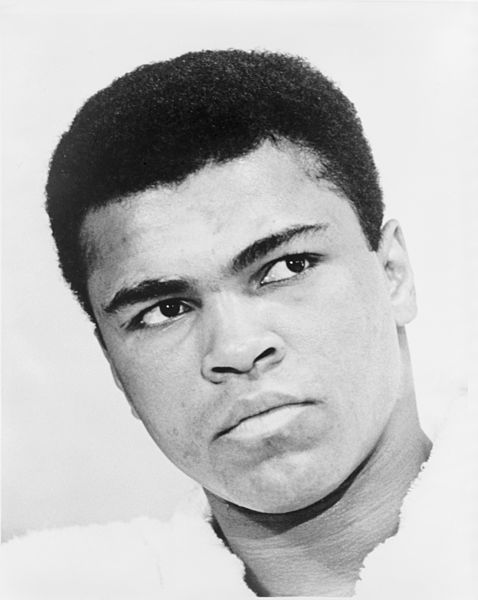
Muhammad Ali became the most recognized human being on the planet, but he started out as Cassius Marcellus Clay Jr., a boy from Louisville’s West End who got into boxing because someone stole his bicycle. The arc between those two facts — a stolen Schwinn and a global icon — runs through a Louisville gym, an Olympic gold medal, a religious conversion, a federal indictment, and a homecoming that the city still marks every June.
A Stolen Bike and the Columbia Gym
Clay was born January 17, 1942, and grew up at 3302 Grand Avenue in Louisville’s West End, the son of sign painter Cassius Clay Sr. and household worker Odessa Grady Clay. In 1954, twelve-year-old Clay rode his new red bicycle to a Louisville event and found it stolen when he came back outside. Furious, he told a police officer he wanted to fight whoever took it.
The officer, Joe Martin, happened to run a boxing gym in the basement of Louisville’s Columbia Auditorium and trained young fighters for a local television program called Tomorrow’s Champions. Martin suggested Clay learn to box before he went looking for anyone. Clay took him up on it, and within six weeks he’d had his first amateur bout. He trained under Martin and later under Fred Stoner, a Black trainer at a gym on Chestnut Street, compiling an amateur record of 100 wins against 8 losses that included two national Golden Gloves titles.
Rome, 1960
Clay won the light heavyweight gold medal at the 1960 Rome Olympics, defeating Poland’s Zbigniew Pietrzykowski in the final. He came home to Louisville a local hero, and his autobiography later claimed that a segregated downtown restaurant refused to serve him despite the medal around his neck, prompting him to throw it into the Ohio River in disgust. Biographers, including Thomas Hauser, have since found no contemporary evidence for the river story and consider it likely embellished; what’s not in dispute is that Clay, medal or not, was still subject to the same Jim Crow restrictions as any other Black Louisvillian in 1960.
He turned professional later that year, backed by the Louisville Sponsoring Group, a syndicate of local businessmen who split his early purses and covered his training expenses. Under trainer Angelo Dundee, Clay ran off a string of wins built on hand speed and lateral movement that were unusual for a heavyweight, describing his own style with the line that would follow him for the rest of his career.
“Float like a butterfly, sting like a bee. The hands can’t hit what the eyes can’t see.”
— Muhammad Ali, popularized with cornerman Drew Bundini Brown, early 1960s
In February 1964, a 22-year-old Clay upset heavyweight champion Sonny Liston in Miami Beach, a fight he’d predicted almost to the round. The next day he confirmed he had joined the Nation of Islam, and shortly after announced he was changing his name first to Cassius X and then to Muhammad Ali, a name given to him by the organization’s leader, Elijah Muhammad.
“I Ain’t Got No Quarrel”
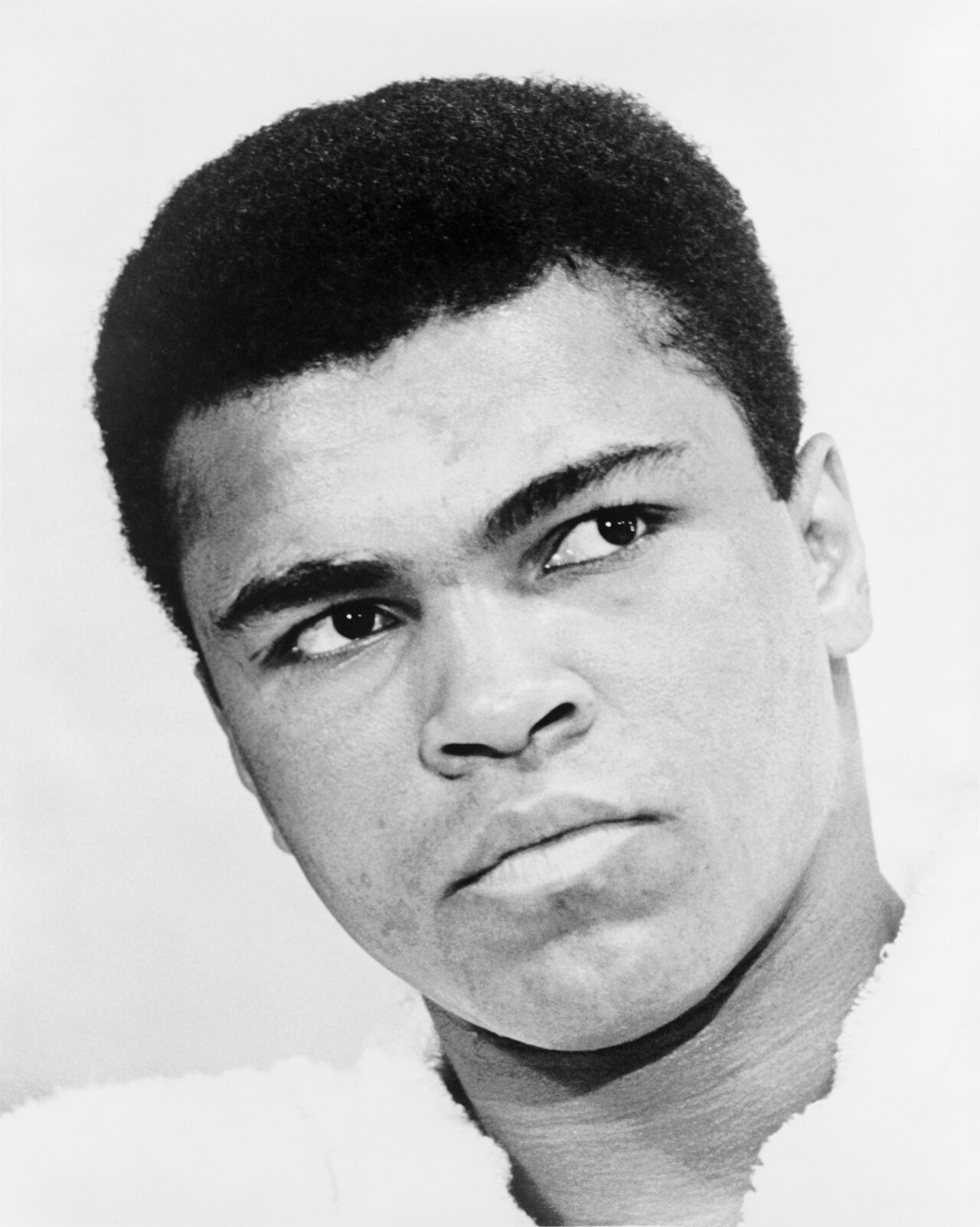
In 1966, reclassified 1-A and eligible for the draft as the Vietnam War escalated, Ali refused induction on religious grounds as a conscientious objector. Asked by reporters about the war, he gave an answer that became one of the most quoted lines of the decade.
“I ain’t got no quarrel with them Viet Cong… no Viet Cong ever called me nigger.”
— Muhammad Ali, 1966, widely reported in contemporary press accounts
He formally refused induction at a Houston induction center on April 28, 1967. Within hours, the New York State Athletic Commission suspended his boxing license and stripped him of his title; other state commissions followed, and he was convicted of draft evasion and sentenced to five years in prison, though he remained free on appeal. He did not fight again for three and a half years, from age 25 to 28, the physical prime of a boxer’s career, while the case worked through the courts. In 1971, the U.S. Supreme Court unanimously overturned his conviction in Clay v. United States, ruling that the Justice Department had improperly advised his draft board.
The Ring, Twice More
Ali returned to boxing in October 1970 and, over the following decade, fought a run of bouts that turned into some of the most watched sporting events in history. He lost a decision to Joe Frazier in their 1971 “Fight of the Century,” then knocked out George Foreman in Zaire in the 1974 “Rumble in the Jungle” to reclaim the heavyweight title, and beat Frazier a third time in the brutal 1975 “Thrilla in Manila.” He won the title a third time in 1978 against Leon Spinks, becoming the first man to win the heavyweight championship three separate times, before retiring for good in 1981.
Outside the ring, Ali had become something closer to a global statesman than an athlete. He traveled to Africa, the Middle East, and Europe on goodwill missions, met with heads of state, and in 1990 flew to Baghdad to negotiate the release of American hostages held by Saddam Hussein ahead of the Gulf War, returning with fifteen freed captives. His willingness to sacrifice years of his athletic prime over a political and religious conviction, rather than accept a safer non-combat military assignment as some other athletes did, reshaped how the public understood the relationship between sports figures and political dissent.
Parkinson’s, the Torch, and Louisville
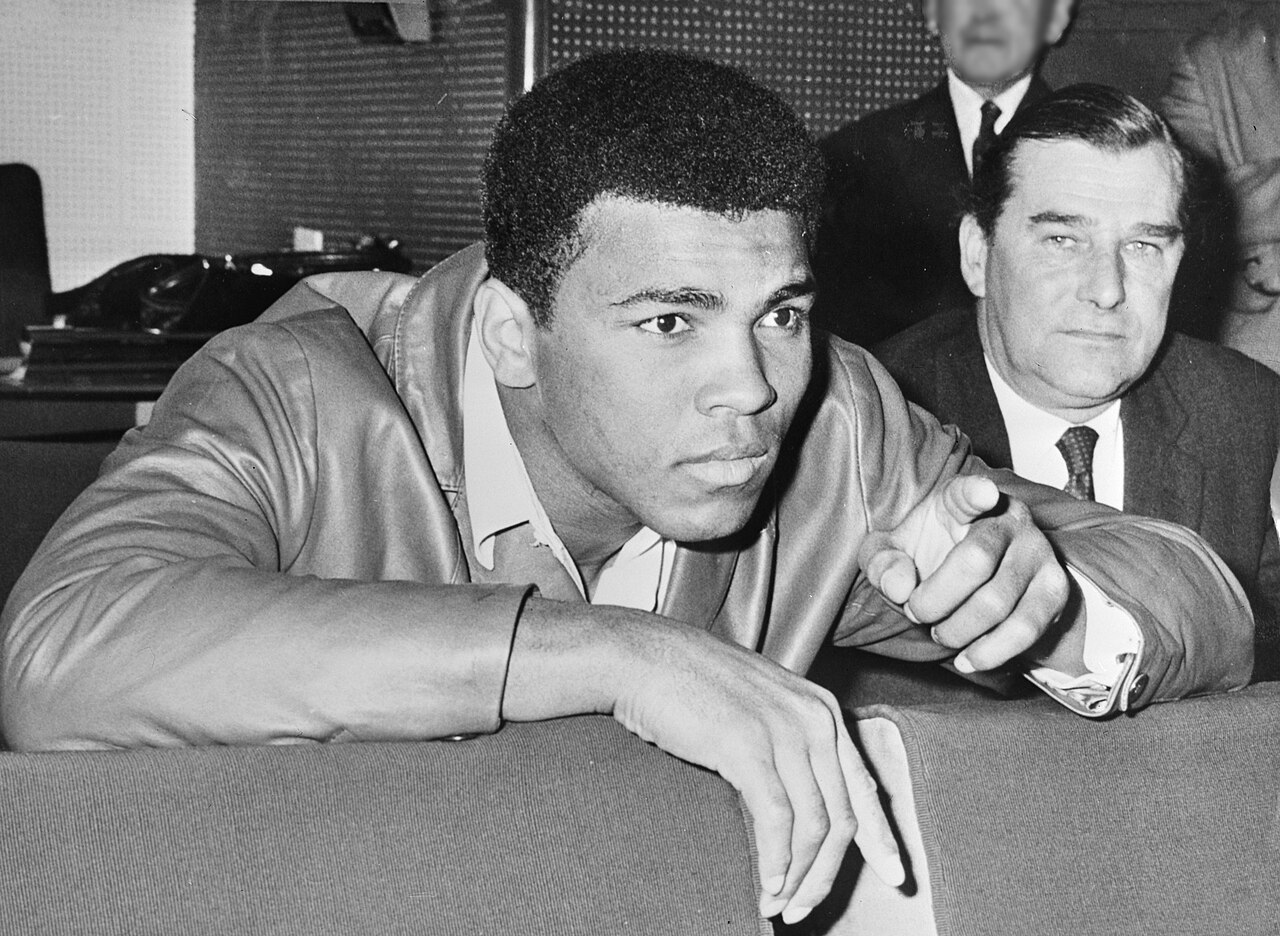
Ali was diagnosed with Parkinson’s syndrome in 1984, three years after his final fight, and his condition gradually became public as tremors and slowed speech replaced the fast talk that had defined him. In 1996 he appeared before a worldwide television audience to light the Olympic cauldron at the Atlanta Games, visibly shaking as he held the torch aloft — a moment widely credited with reintroducing him to a generation too young to remember him fighting.
He and his wife Lonnie opened the Muhammad Ali Center in downtown Louisville in November 2005, a museum built around his six core values — confidence, conviction, dedication, giving, respect, and spirituality — rather than a boxing hall of fame. Ali died on June 3, 2016, of septic shock related to his Parkinson’s; his funeral procession wound through Louisville past his childhood home before a memorial service that drew world leaders and past opponents alike. In 2019, Louisville International Airport was renamed Muhammad Ali International Airport in his honor.
“Service to others is the rent you pay for your room here on earth.”
— Muhammad Ali
Sources and further reading
- Childhood and Columbia Gym origin — Muhammad Ali Center and NPR’s “Muhammad Ali’s Louisville Roots“
- Olympic record and the Louisville Sponsoring Group — Britannica and the University of Louisville’s Muhammad Ali: A Transcendent Life archive
- Draft refusal, suspension, and the Supreme Court case — Britannica and contemporary press coverage via the UofL Ali archive
- The 1996 Atlanta torch lighting and the founding of the Muhammad Ali Center — Muhammad Ali Center
- Funeral and airport renaming — published Louisville news coverage via The Courier-Journal
More from Louisville
King of the World: Muhammad Ali and the Rise of an American Hero
David Remnick’s account of the young Cassius Clay’s rise, for readers who want more than the highlight reel.
Louisville Year-Round: Things to Do Beyond Derby Week
See the city Ali grew up in, from the West End to downtown, any month of the year.
Famous People from Louisville
Ali’s hometown roster of boxers, astronauts, and movie stars, several with roots in the same West End streets.