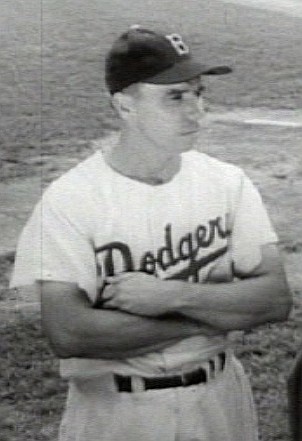
Pee Wee Reese is remembered in Louisville for two things that happened decades apart: winning a marbles championship as a kid on the city’s south side, which gave him the nickname that outlived his given name, and refusing to sign a petition against a new Black teammate a decade later, a decision quiet enough that it barely made news at the time and loud enough that it still gets retold today. Between those two moments sat one of the great shortstop careers in baseball history.
A Marbles Champion Named Pee Wee
Harold Henry Reese was born in Ekron, in Meade County, Kentucky, and moved with his family to Louisville when he was nearly eight years old. As a boy he became the city’s marbles champion, a competitive pastime that was taken seriously enough in Louisville at the time that a citywide title meant something. The small marbles used in the game were nicknamed “pee wees,” and the name stuck to Reese himself for the rest of his life, following him all the way to Brooklyn and into the Hall of Fame decades later.
Reese was not a large man by baseball standards, which made the nickname fit twice over, but his skill at shortstop, both defensively and as a table-setting hitter, made him one of the most consistently valuable players of his era regardless of his frame.
Reese signed with the Louisville Colonels, a minor league club, before the Boston Red Sox owned the team and eventually sold his contract to the Brooklyn Dodgers in 1938, a deal driven partly by concerns from Red Sox management that incumbent shortstop Joe Cronin, who was also the team’s manager, would not welcome a talented rookie challenging his job. The trade turned out to be one of the more consequential transactions in Dodgers history, delivering Brooklyn a shortstop and eventual team captain for the better part of two decades.
Brooklyn’s Shortstop
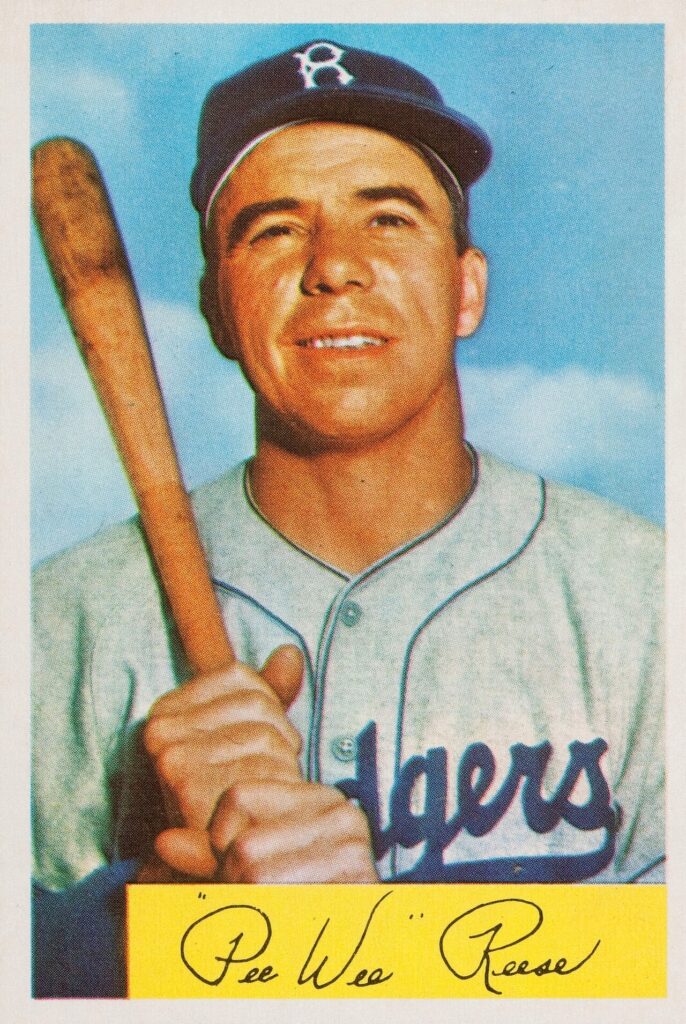
Reese played shortstop for the Brooklyn and then Los Angeles Dodgers from 1940 to 1958, missing three seasons in the middle of his career to serve in the U.S. Navy during World War II. He made ten All-Star teams and helped the Dodgers to seven National League pennants, captaining a roster that included some of the most talented players of the postwar era. He was inducted into the Baseball Hall of Fame in 1984, a recognition of a career built on steady excellence rather than any single dominant season.
His Navy service, like many major leaguers of his generation, took him out of the game during three of what would have been his physical prime seasons, a common sacrifice among ballplayers who served during World War II. He returned to Brooklyn in 1946 and quickly resumed his role as the team’s everyday shortstop, helping anchor the “Boys of Summer” era Dodgers teams that dominated the National League through the late 1940s and 1950s, even as the team repeatedly fell short of a title against the Yankees in the World Series before finally breaking through in 1955.
The Petition He Didn’t Sign
In 1947, when the Dodgers were preparing to bring Jackie Robinson up from their Montreal farm team and break baseball’s color line, a handful of Dodgers players circulated a petition objecting to playing alongside a Black teammate. Because Reese was from Louisville, a Southern city, some of the players organizing the petition assumed he would be an easy signature. He refused.
Reese never made a public production of the refusal, and accounts of exactly what he said at the time vary, but the decision itself is well documented in baseball histories of the Robinson era: the Kentucky-born shortstop who might have been the petition’s easiest recruit instead declined to add his name, and the effort collapsed without enough support to matter.
The Arm Around Robinson
The moment most closely associated with Reese and Robinson’s relationship came during a game, commonly placed in Cincinnati, when a hostile, heckling crowd was directing racist abuse at Robinson from the stands. Reese walked over to his teammate at second base and put his arm around him in a visible show of solidarity in front of the crowd, a gesture that quieted the ballpark and became one of the most retold images of baseball’s integration era.
I was just trying to make the world a little bit better. That’s all.
— Pee Wee Reese, on his relationship with Jackie Robinson
Historians have since debated the precise date and location of the moment, and some details have been embellished or conflated across retellings over the decades, but the core relationship it represents, a Southern-born team captain who publicly backed his Black teammate rather than distancing himself from him, is not in dispute among Reese’s contemporaries or baseball historians. Robinson himself credited Reese’s support, both public and private, as meaningful during a season in which Robinson faced hostility from opposing players, fans, and even some of his own teammates.
The two men went on to form a genuine double-play partnership on the field for years, with Reese at shortstop and Robinson eventually settling in at second base, a defensive pairing that helped anchor the Dodgers infield through their championship seasons. Off the field, teammates and journalists who covered the club described a friendship that deepened over the course of their playing careers, well beyond the single widely told moment at second base, as the two men spent a decade as teammates navigating the pressures of integration together.
Legacy
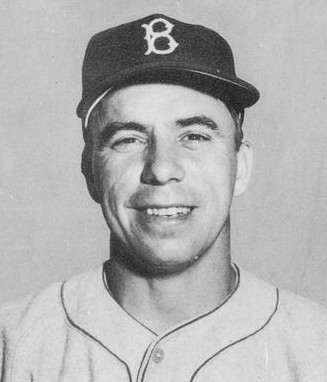
A statue depicting Reese with his arm around Robinson stands outside the Brooklyn Cyclones’ ballpark at KeySpan Park in Coney Island, a permanent public marker of a moment that started, in some tellings, with a Louisville marbles champion who simply refused to sign a piece of paper. Reese’s on-field résumé, ten All-Star selections, seven pennants, and a Hall of Fame plaque, would have secured his place in baseball history on its own. What has kept his name circulating well outside of box scores is the quieter decision he made off the field, in a Brooklyn clubhouse, about the kind of teammate he was willing to be.
After retiring as a player, Reese moved into broadcasting, working as a television commentator on baseball games for years and remaining a familiar public figure well after his playing career ended. He died in 1999, and tributes at the time consistently returned to the same two threads that had defined his public image for half a century: a shortstop good enough to reach Cooperstown on the strength of his glove and bat alone, and a Kentucky-born teammate whose quiet refusal to go along with a petition, and whose public support of Robinson afterward, made him part of one of baseball’s most important stories almost by accident.
Sources and further reading
- Childhood, marbles nickname, and Louisville upbringing — Wikipedia and the Baseball Hall of Fame biography (baseballhall.org)
- Playing career and All-Star record — the Society for American Baseball Research (SABR) BioProject and Baseball-Almanac
- 1947 petition and the arm-around-Robinson moment — MLB.com’s “Why We Love Baseball” feature and Britannica
- Coney Island statue — published sports journalism, via the Brooklyn Cyclones’ own history of the statue