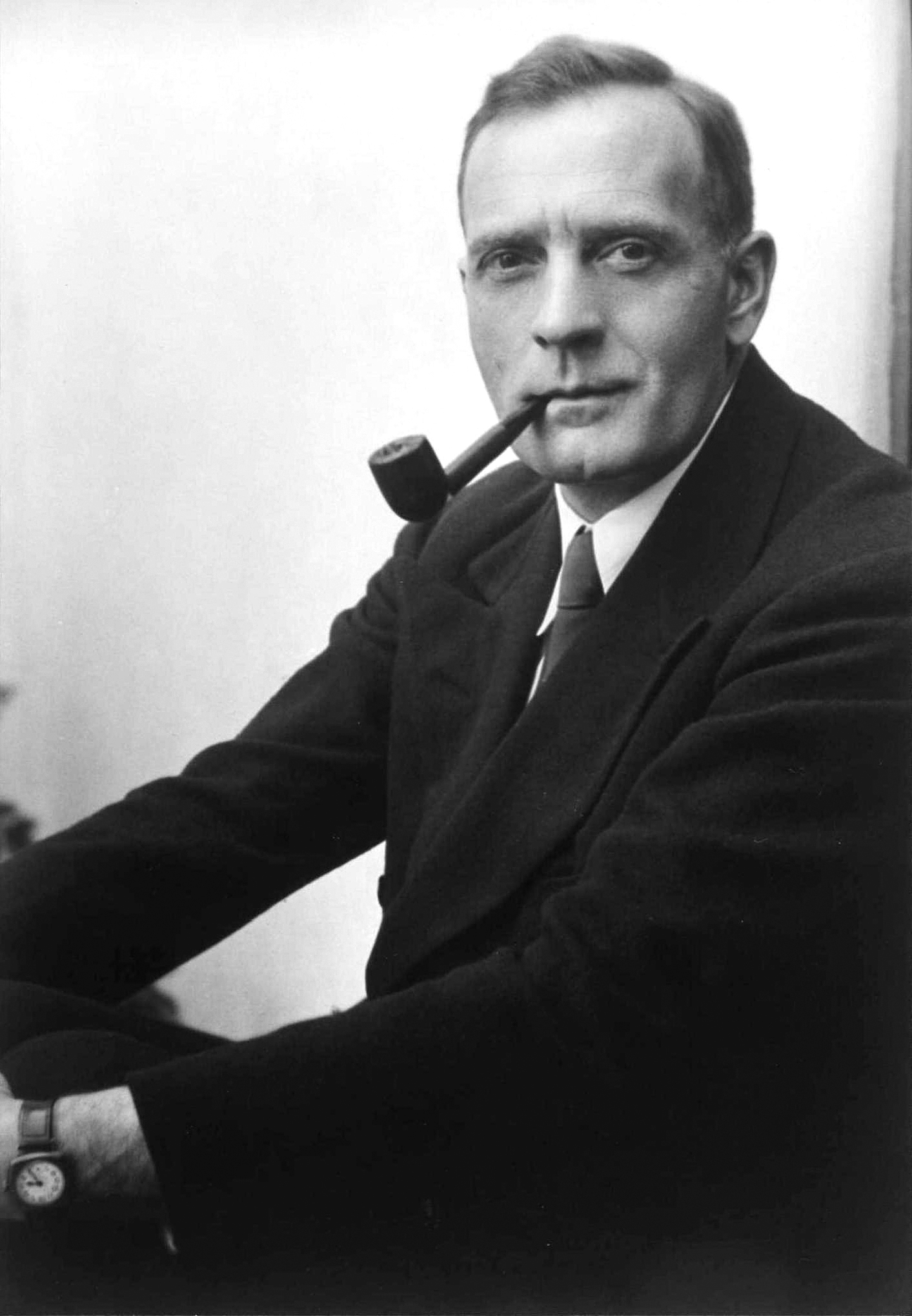
Edwin Hubble is remembered as the astronomer who proved the universe was larger, and stranger, than anyone had imagined, but for five years before any of that, he was a dutiful son living in Louisville, Kentucky, trying to become a lawyer to satisfy his dying father. He passed the Kentucky bar, taught high school across the river in Indiana, and coached a basketball team, all while the discoveries that would make him famous were still years away at an observatory he had not yet seen.
A Reluctant Lawyer
Hubble was born in Marshfield, Missouri, in 1889 and had shown an early, intense interest in astronomy, but his father, an insurance executive named John Powell Hubble, wanted a lawyer in the family and objected strongly to any career in science. In 1909, the elder Hubble moved the family from Chicago to Shelbyville, Kentucky, and by 1911 they had settled into a house at 1318 Brook Street in Louisville.
Hubble, meanwhile, had won a Rhodes Scholarship out of the University of Chicago and left for Oxford in 1910. There, honoring his father’s wishes, he studied jurisprudence rather than science, along with literature and Spanish, eventually earning a graduate degree in law he had little intention of using.
Called Home to Louisville
John Powell Hubble died at the family’s Brook Street home in the winter of 1913 while Edwin was still in England. He is buried in Louisville’s Cave Hill Cemetery, in Section 8, alongside generations of the city’s other notable dead. Edwin returned that summer to look after his mother, two sisters, and a younger brother.
To make room for Edwin and another visiting brother, the family moved once more, this time to a house at 1287 Everett Avenue in Louisville’s Highlands neighborhood, where Edwin would live for the following year. He spent part of that summer translating Spanish documents for a local import company, an ordinary, unglamorous job for a man who would eventually redraw the scale of the known universe.
Admitted to the Kentucky Bar
On September 2, 1913, Hubble passed the Kentucky bar examination, technically fulfilling the promise he had made his father. His heart was never in it. Biographers describe his brief legal career in Louisville as halfhearted, and it amounted to less than a year of desultory practice before he abandoned law for good.
With his father gone, the pressure that had steered Hubble toward the law began to lift, though he did not immediately return to astronomy. Instead, that fall, he took a job that had nothing to do with either subject: teaching high school across the Ohio River from his mother’s Louisville home.
Teaching and Coaching Across the River
In the fall of 1913, Hubble was hired to teach Spanish, physics, and mathematics at New Albany High School in New Albany, Indiana, just across the river from his family’s Louisville home, and to coach the boys’ basketball team. An accomplished college athlete himself, who had played basketball, football, and track at the University of Chicago, Hubble led the New Albany team to a third-place finish in the state championship tournament that year.
He was, by all accounts, a popular teacher. The 1914 New Albany High School yearbook was dedicated to him, a small but telling honor for a young instructor only a few years removed from his own undergraduate days. Nothing about the job, however, resembled the career his father had envisioned or the one Hubble himself would eventually pursue.
Leaving Louisville for the Stars
When the school term ended in May 1914, Hubble applied to return to the University of Chicago, this time as a graduate student in astronomy rather than a law student steered by his father. He was accepted, and in August 1914 he left Louisville for good, moving to the university’s Yerkes Observatory in Wisconsin to begin the career that had drawn him since boyhood.
At Yerkes, Hubble had access to a 40-inch refracting telescope and an innovative 24-inch reflector, and in 1917 he completed a doctoral dissertation titled “Photographic Investigations of Faint Nebulae.” His mother and remaining siblings left Louisville behind as well, relocating to Madison, Wisconsin, in 1916, closing the Kentucky chapter of the family’s story for good.
Discoveries at Mount Wilson
After brief service in the Army during the First World War, Hubble was offered a staff position at the Carnegie Institution’s Mount Wilson Observatory near Pasadena, California, in 1919, and he remained there for the rest of his career. His arrival coincided with the completion of the Hooker Telescope, then the largest in the world, which he used to identify individual stars inside what astronomers had assumed were clouds of gas and dust within our own Milky Way.
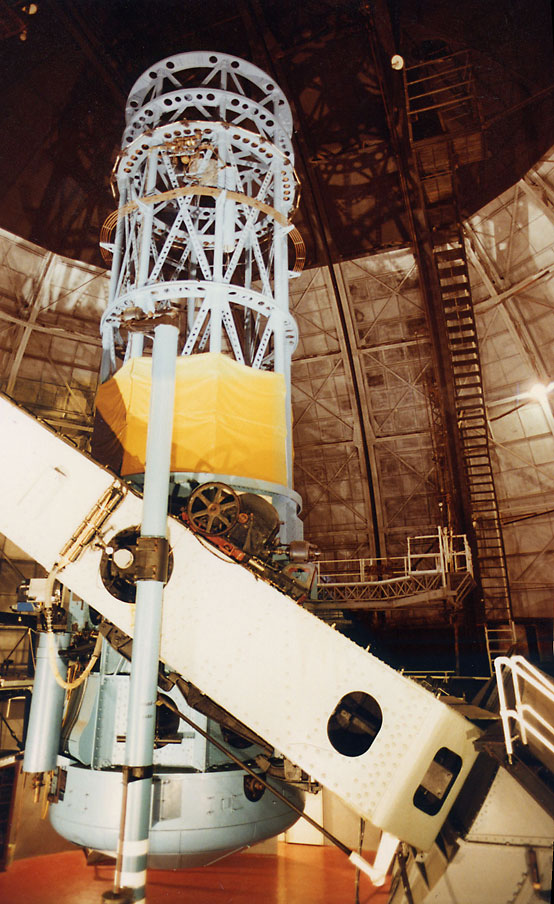
Using the Hooker Telescope, Hubble identified Cepheid variable stars in the Andromeda and Triangulum nebulae, and by measuring their brightness he calculated that these objects lay far outside the Milky Way. His 1924 findings, first announced to The New York Times and then to the American Astronomical Society, proved that the universe contained countless galaxies beyond our own, overturning a century of astronomical assumption.
Five years later, in 1929, Hubble went further still. Comparing the distances of galaxies with the redshift of their light, he showed that the farther away a galaxy sat, the faster it appeared to be receding from Earth, a relationship that became known as Hubble’s Law. The implication, worked out further over the following decades, was that the universe itself was expanding, a conclusion that reshaped physics and cosmology alike.
A Universe Explained
Hubble wrote about his discoveries for popular audiences as well as fellow scientists, and two of his lines have outlasted the technical papers that made his reputation. Writing for a general readership in 1929, the same year he formulated his law of cosmic expansion, he described the scientific enterprise itself in plain, almost boyish terms.
“Equipped with his five senses, man explores the universe around him and calls the adventure Science.”
— Edwin Hubble, “The Exploration of Space,” Harper’s Magazine, May 1929
Seven years later, delivering the Silliman Lectures at Yale that became his book The Realm of the Nebulae, he offered a summary of his own field that has since become one of the most quoted lines in the history of astronomy.
“The history of astronomy is a history of receding horizons.”
— Edwin Hubble, The Realm of the Nebulae, 1936
Legacy
Hubble spent his final years lobbying, ultimately without success in his own lifetime, to have the Nobel Prize in Physics recognize astronomical work, and he was briefly the first astronomer to use the 200-inch Hale Telescope at Palomar Observatory before his death in 1953. He suffered a fatal blood clot at his home in San Marino, California, and his wife, Grace, never publicly revealed where he was buried.
When NASA named its orbiting observatory the Hubble Space Telescope in 1990, it cemented his name in the public imagination far beyond the technical achievements of Hubble’s Law. Louisville rarely factors into that legacy, since most biographical sketches skip from his Rhodes Scholarship straight to Mount Wilson, but the city was where the future astronomer buried his father, passed the bar to please him, and taught high school basketball before turning, at last, back to the stars.
Sources and further reading
- Sources and further reading: “Edwin Hubble, Family, and Friends in Louisville, 1909-1916,” University of Louisville Department of Physics and Astronomy
- “Edwin Hubble at New Albany High School,” University of Louisville
- Edwin Hubble, Wikipedia
- “Case Files: Edwin Hubble,” The Franklin Institute
- The Realm of the Nebulae quotations, Goodreads
More from Louisville
Thomas Edison
Another figure whose Louisville years came long before the achievements the history books remember him for.
Louisville Year-Round: Things to Do Beyond Derby Week
The city Hubble briefly called home, worth a visit outside Derby week.
Historical Timeline of Louisville
Hubble’s Louisville chapter set against 250 years of the city’s history.