Before he was directing Robin Williams to an Oscar or winning the Palme d’Or in the Pacific Northwest city he made his own, Gus Van Sant was a newborn in Louisville, Kentucky — the son of a traveling clothing salesman who would move his family through half a dozen towns before Van Sant finished high school.
He went on to become one of only two filmmakers, alongside Joel Coen, to win both the Palme d’Or and the Cannes Best Director prize in the same year. He earned two Academy Award nominations for Best Director, for Good Will Hunting and Milk. He rarely discusses Louisville. He was gone long before he was old enough to remember much of it.
A Salesman’s Son, Never Long in One Place
Gus Green Van Sant Jr. was born in Louisville on July 24, 1952, to Gus Green Van Sant Sr. and Betty Seay Van Sant. His father was a traveling clothing salesman who worked his way into executive marketing positions, eventually serving as president of the White Stag Manufacturing Company’s apparel operation.
The elder Van Sant’s career meant the family moved constantly. Van Sant attended Darien High School in Darien, Connecticut, then finished his schooling at The Catlin Gabel School in Portland, Oregon, where his family eventually settled.
One interest followed him through every move: painting and Super-8 filmmaking. He was already shooting semi-autobiographical short films, some costing as little as thirty dollars, before he ever left for college.
In 1970 he enrolled at the Rhode Island School of Design intending to study painting. Exposure to avant-garde directors there changed his mind, and he switched his major to cinema, graduating with a degree in film in 1975.
Movies for Thirty Dollars
After a stint as a Los Angeles production assistant and two years writing copy at a New York advertising agency, Van Sant saved $20,000 and relocated to Portland, Oregon, in 1983 — the city that would become the backdrop for nearly all of his early work.
Portland is a city of a million people, yet it’s a town, small enough that people are familiar faces, even though you don’t know them.
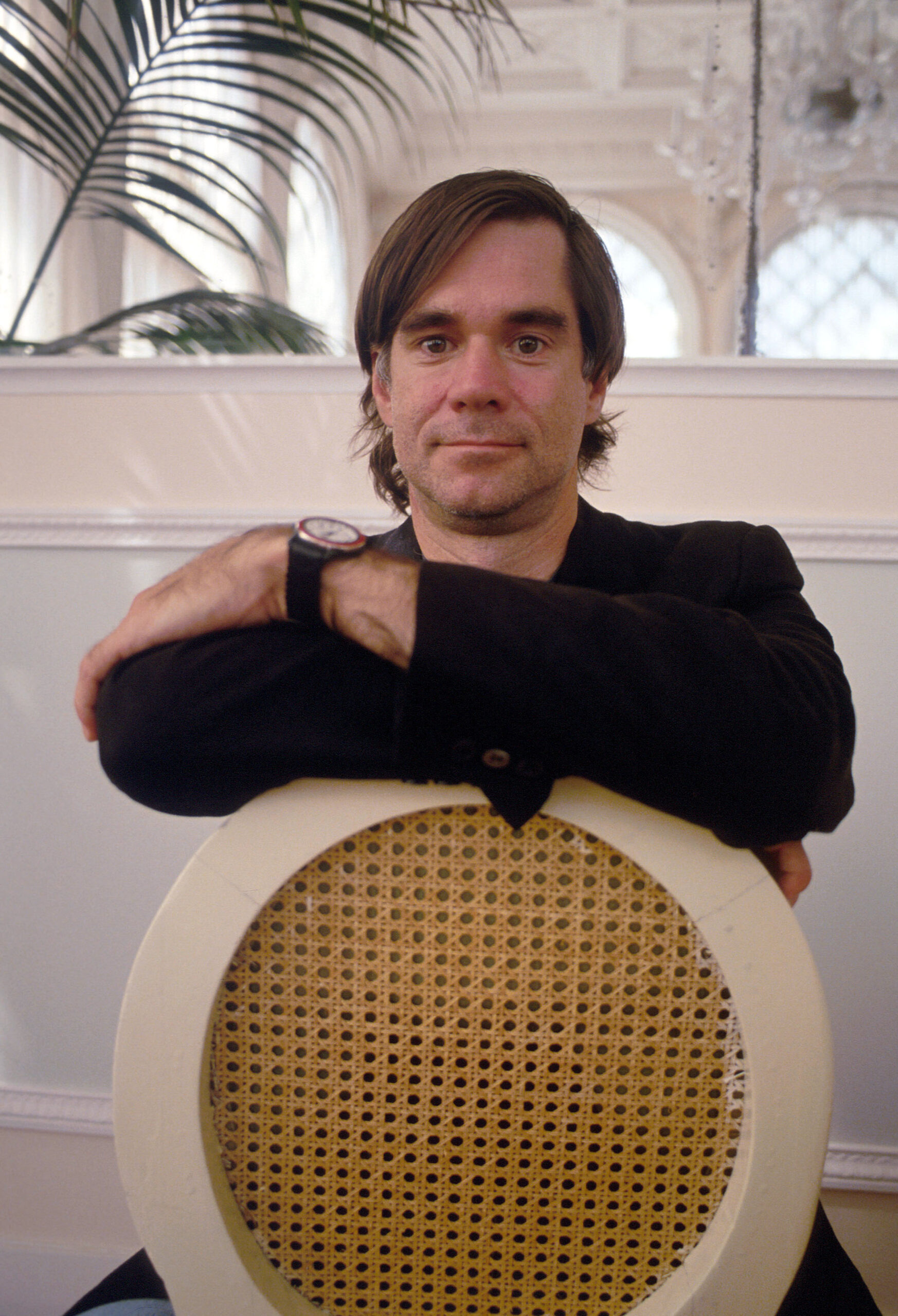
Gus Van Sant, 2011
He used his savings to finance Mala Noche (1985), a black-and-white film about a gay liquor store clerk’s unrequited love for a Mexican immigrant, adapted from a novella by Portland street writer Walt Curtis.
Shot in cinema-verite style and first shown as an underground film, Mala Noche was named the year’s best independent film by the Los Angeles Times when it reached wider release in 1987, launching Van Sant’s career.
The Outsiders of Drugstore Cowboy and My Own Private Idaho
Van Sant’s early Hollywood momentum led nowhere. Universal Pictures briefly courted him, then passed on every idea he pitched. He went back to Portland and made the films himself.
Drugstore Cowboy (1989) followed four addicts robbing pharmacies to support their habit. It revived Matt Dillon’s career and won Van Sant the National Society of Film Critics’ award for Best Director, along with an Independent Spirit Award for his screenplay.
My Own Private Idaho (1991) came next, starring River Phoenix and Keanu Reeves as two male hustlers navigating unrequited love and the idea of family — themes Van Sant returned to throughout his career. Phoenix won a Venice Film Festival acting honor for the role, and Van Sant won a second consecutive Independent Spirit Award for his screenplay.
A big-budget 1993 adaptation of Tom Robbins’s Even Cowgirls Get the Blues, starring Uma Thurman and Keanu Reeves, proved a critical and commercial disaster — a stumble Van Sant would need a genuine comeback from.
Discovering a Movie Star
That comeback arrived with To Die For (1995), Van Sant’s first film for a major studio. During casting, a 24-year-old actor named Matt Damon read for a supporting role that ultimately went to Joaquin Phoenix. Van Sant recalled the audition in a 2024 interview:
After his first read, Laura Ziskin turned to me after he was gone and said, ‘That’s a movie star.’ I was like, ‘Really?’ I can’t call things like that.
Gus Van Sant, 2024, on producer Laura Ziskin’s reaction to Matt Damon’s audition
Damon didn’t get the part — Van Sant felt he read as too all-American for a teenager meant to be seduced into murder — but the two would cross paths again within two years, under very different circumstances.
To Die For itself became a critical hit, starring Nicole Kidman as a murderously ambitious weathergirl, and it gave Van Sant the standing to make the film that would define the rest of his career.
Good Will Hunting
In 1997, Van Sant received a script written by two little-known actors, Matt Damon and Ben Affleck, about a troubled janitor with a gift for mathematics. Miramax nearly moved on to a bigger-name director before Van Sant’s interest brought him back into contention.
I always want my characters to be lesser known, so you have a chance to meet somebody new as opposed to a film where you’re going to see a particular person play a role. I always want the audience to get lost in the character.
Gus Van Sant, 2024
Good Will Hunting earned nine Academy Award nominations, including Best Director for Van Sant, and won two: Best Original Screenplay for Damon and Affleck, and Best Supporting Actor for Robin Williams.
On set, Williams took to calling Van Sant “the mellowest man in Hollywood,” and accepting his Oscar, joked that his director was “being so subtle you’re almost subliminal.” Van Sant has said he simply trusts actors’ instincts and stays quiet so they can work.
Milk
In 2008, Van Sant directed Milk, a biopic of assassinated San Francisco city supervisor Harvey Milk, the first openly gay person elected to major public office in California. Sean Penn starred in the title role.
The film received eight Oscar nominations, including Best Picture and Best Supporting Actor for Josh Brolin as Dan White, Milk’s assassin. It won two: Best Actor for Penn and Best Original Screenplay for Dustin Lance Black. Van Sant earned his second Best Director nomination. He later called working with Penn “amazing.”
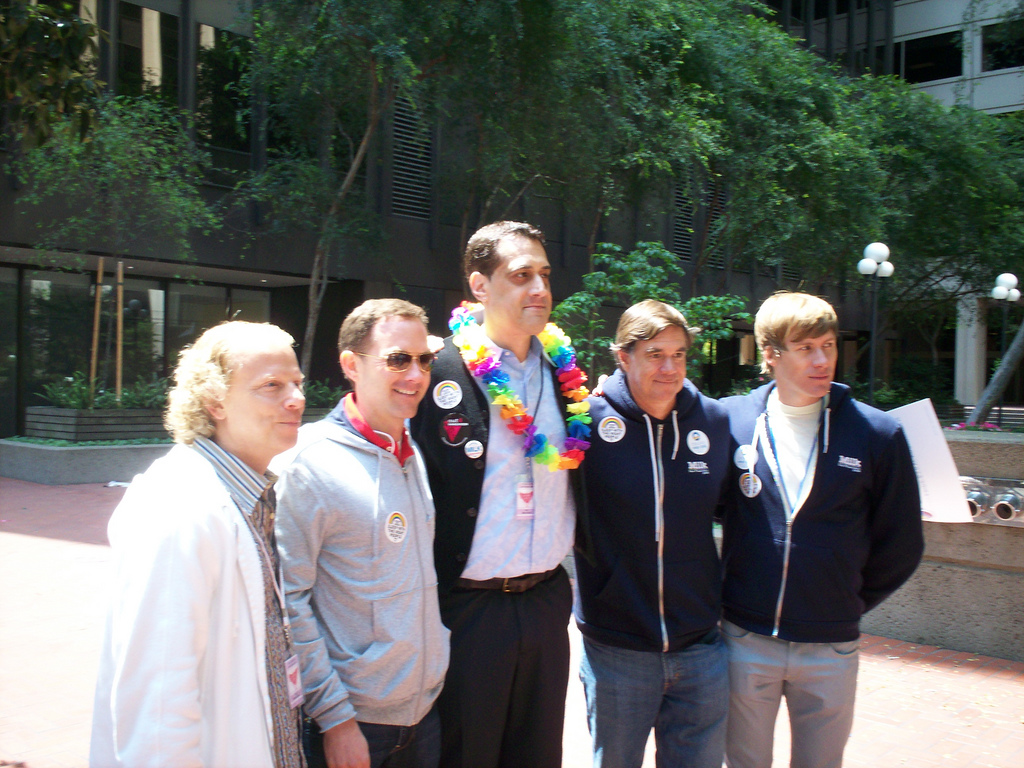
That June, Van Sant marched with Milk’s real-life nephew, Stuart Milk, and the film’s producers and writer in San Francisco’s Pride parade, seen above — months before the film’s release.
Palme d’Or in Portland
Van Sant’s most acclaimed independent work came from what he called his Death Trilogy — Gerry (2002), Elephant (2003), and Last Days (2005), a fictionalized account of Kurt Cobain’s final days.
For Elephant, a fictionalized account of the 1999 Columbine High School massacre, Van Sant returned to Portland and cast dozens of untrained teenagers instead of professional actors.
The film won both the Palme d’Or and the Best Director prize at the 2003 Cannes Film Festival, making Van Sant one of only two filmmakers — the other is Joel Coen — to win both awards in the same year.
Legacy of an Outsider
Van Sant has spent nearly all of his life far from Kentucky: three decades based in Portland, and more recently Los Angeles, where he continues to direct television — including six episodes of 2024’s Feud: Capote vs. the Swans — and to paint. In 2025, the Venice Film Festival gave him its Campari Passion for Film award, honoring a career built almost entirely outside the Hollywood system.
But Louisville is where it started: a newborn son of a traveling salesman, in a family that kept moving until the boy found, in film, the one thing he could carry with him wherever he went next.