Jack McCall’s claim on history rests entirely on one act of cowardice, but the record of his life traces back to a modest home in Louisville, Kentucky, where his parents and three sisters lived while their son drifted west under a false name. On August 2, 1876, that son walked into a saloon in Deadwood, Dakota Territory, and shot the frontier lawman Wild Bill Hickok in the back of the head, ending Hickok’s life and beginning McCall’s own short, strange path to the gallows.
A Louisville Family
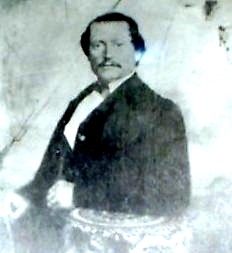
John “Jack” McCall was born around 1852, most likely in Jefferson County, Kentucky, and raised there alongside three sisters. Newspapers of the day described him as having thick chestnut hair inclined to curl, a small sandy mustache, a double chin, and one eye crossed, a description that would later help confirm his identity to family a thousand miles away.
By the early 1870s, McCall had left Louisville for the Kansas-Nebraska border country, working among a group of buffalo hunters before drifting through Wyoming Territory. By 1876, he had arrived in the gold camp of Deadwood, going by the alias “Bill Sutherland,” a young man with no fixed trade and, by most accounts, a habit of losing money at cards faster than he could earn it.
The Killing of Wild Bill Hickok
On the afternoon of August 1, 1876, McCall joined a poker game at Nuttal & Mann’s Saloon No. 10 in Deadwood, sitting across from Hickok, the famous gunfighter and sometime lawman. McCall lost hand after hand until he had nothing left. Hickok, taking pity on him, handed over money for breakfast and advised him not to play again until he could cover his losses. McCall took the money, but felt insulted by the gesture.
The next afternoon, Hickok broke his usual habit of sitting with his back to the wall, since his preferred chair was already taken. Playing cards with his back exposed to the room, he remarked to another player about the hand he’d just been dealt.
“The old duffer — he broke me on the hand.”
— Wild Bill Hickok’s last words, moments before he was shot
McCall, drinking at the bar, walked up behind Hickok, drew a .45-caliber revolver, and fired a single shot into the back of his head. “Damn you! Take that!” he shouted as Hickok slumped forward, dead before he hit the floor. McCall fled out the back door, tried to escape on a tethered horse, and fell when the saddle slipped loose. He was captured within minutes.
A Miners’ Court Acquittal
Deadwood had no legally recognized government in 1876, so the mining camp convened its own impromptu court the following day, staffed by local miners and businessmen acting as judge, prosecutor, and jury. McCall testified that Hickok had killed his brother back in Abilene, Kansas, and that he had shot him in revenge. It was untrue; McCall had no brother. The jury deliberated less than two hours and returned a verdict of not guilty.
The verdict outraged much of the territory. The Black Hills Pioneer published a scathing response to the acquittal, one that has followed the case ever since.
“Should it ever be our misfortune to kill a man … we would simply ask that our trial may take place in some of the mining camps of these hills.”
— Black Hills Pioneer, August 5, 1876
McCall lingered in Deadwood for a few days until he was advised, none too gently, that his safety could not be guaranteed if he stayed. He left for Wyoming Territory, where he made the mistake of bragging in saloons and stage stops about killing the famous Wild Bill Hickok.
A Second Trial and Execution
McCall’s boasting reached a U.S. deputy marshal in Laramie, Wyoming, who arrested him on August 29, 1876. Federal authorities argued that the Deadwood acquittal carried no legal weight, since the camp sat on unorganized land with no valid court, and double jeopardy did not apply. McCall was taken to Yankton, Dakota Territory, to stand trial a second time, this time before a legitimate federal court.
The trial opened on December 4, 1876. No witnesses were called for the defense, and the jury returned a guilty verdict two days later. McCall claimed he had been too drunk to remember the shooting and asked for a new trial, even insisting that “Jack McCall” was not his real name and that he had changed it as a boy. Judge Granville Bennett was unmoved and sentenced him to hang.
While awaiting execution, McCall read the Bible, met with priests, and corresponded with strangers who wrote asking for his autograph. On the gallows in Yankton on March 1, 1877, as the noose was fitted around his neck, he reportedly offered one final instruction.
“Draw it tighter, Marshal.”
— Jack McCall’s last words before his execution, March 1, 1877
He was hanged at 10:15 that morning, the first person legally executed in Dakota Territory. He was twenty-four years old.
A Letter From Louisville
Four days before McCall’s sentencing, a letter arrived at the Yankton marshal’s office from the Merchants Hotel in Louisville. It was written by Mary A. McCall, who had read a newspaper account of the sentencing of Wild Bill Hickok’s killer and recognized details that matched a son who had vanished years before.
“There was a young man by the name of John McCall left here about six years ago, who has not been heard from for the last three years. He has a father, mother and three sisters living here in Louisville, who are very uneasy about him since they heard about the murder of Wild Bill. … This John McCall is about twenty-five years old, has light hair, inclined to curl, and one eye crossed. I cannot say about his height, as he was not grown when he left here.”
— Mary A. McCall, letter to the Marshal of Yankton, February 25, 1877
The description, down to the crossed eye, matched McCall precisely. Whether the family ever received a reply, or learned the fate of the son they had been searching for, is not recorded. Days later, McCall destroyed a letter he had drafted for the local paper explaining his motive, and went to the gallows still refusing to say clearly why he had killed Hickok.
Legacy
McCall was buried in Yankton’s Catholic cemetery. When the cemetery was relocated in 1881, workers exhumed his body and found the noose still knotted around his neck. His remains were reburied in an unmarked grave whose exact location has since been lost.
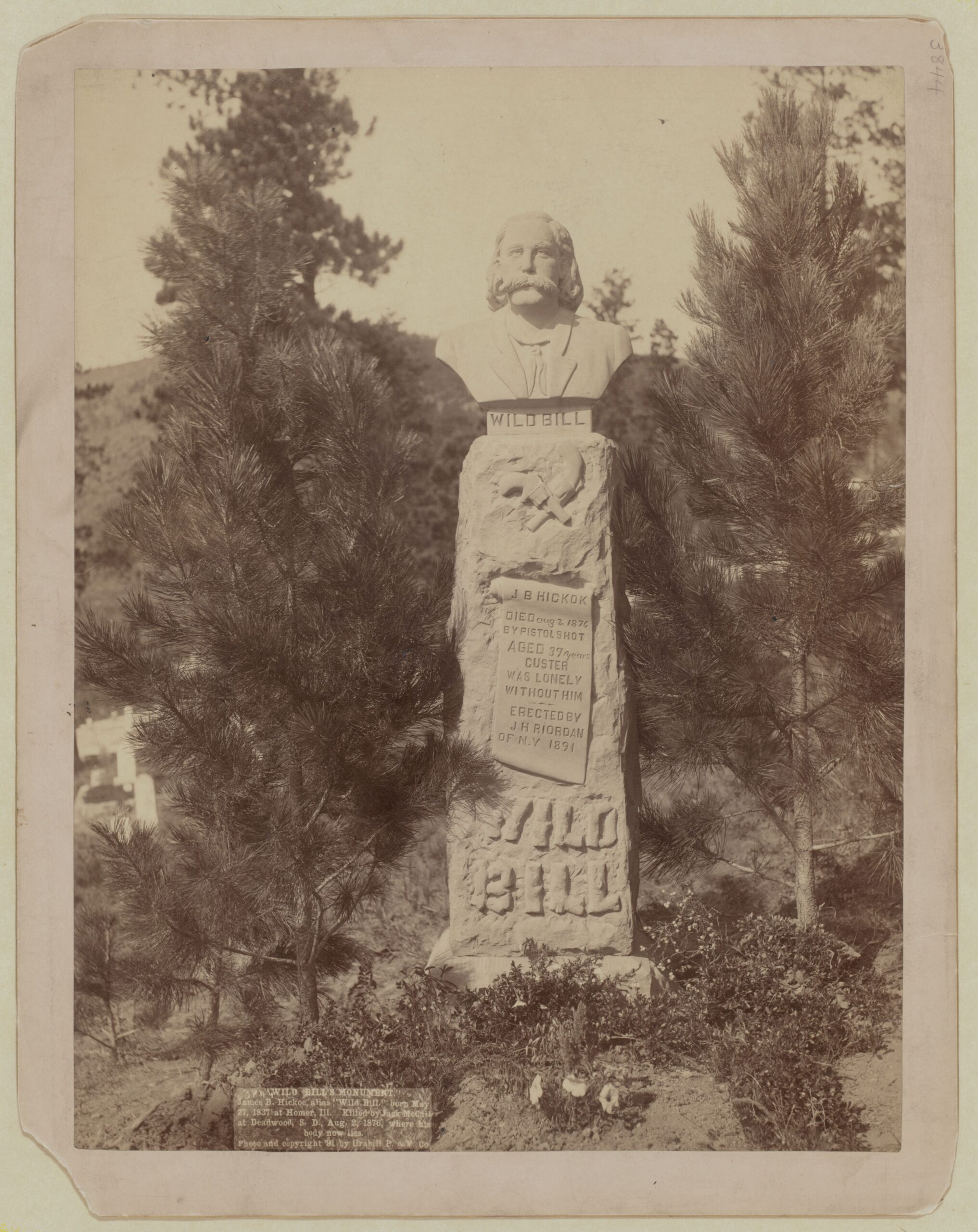
Hickok’s death and McCall’s capture are reenacted most summer evenings on Deadwood’s Main Street, followed by a staged version of the miners’ trial that has run since 1924. McCall himself has been portrayed on screen by Porter Hall in The Plainsman, Lon Chaney Jr. in Badlands of Dakota, and Garret Dillahunt in HBO’s Deadwood, each retelling a story whose central facts have never fully been settled.
What is settled is the letter from the Merchants Hotel: a mother in Louisville, writing to a marshal a thousand miles away, describing a son’s crossed eye and curling hair, still hoping in February 1877 that the man about to hang in Dakota Territory was not hers.
Sources and further reading
- Jack McCall, Wikipedia
- “Jack McCall – Cowardly Killer of Wild Bill Hickok,” Legends of America
- “Jack McCall & The Murder of Wild Bill Hickok,” Black Hills Visitor Magazine, August 28, 2017
- “Wild Bill Hickok is murdered,” HISTORY
- “Trial of Jack McCall,” Deadwood Alive