
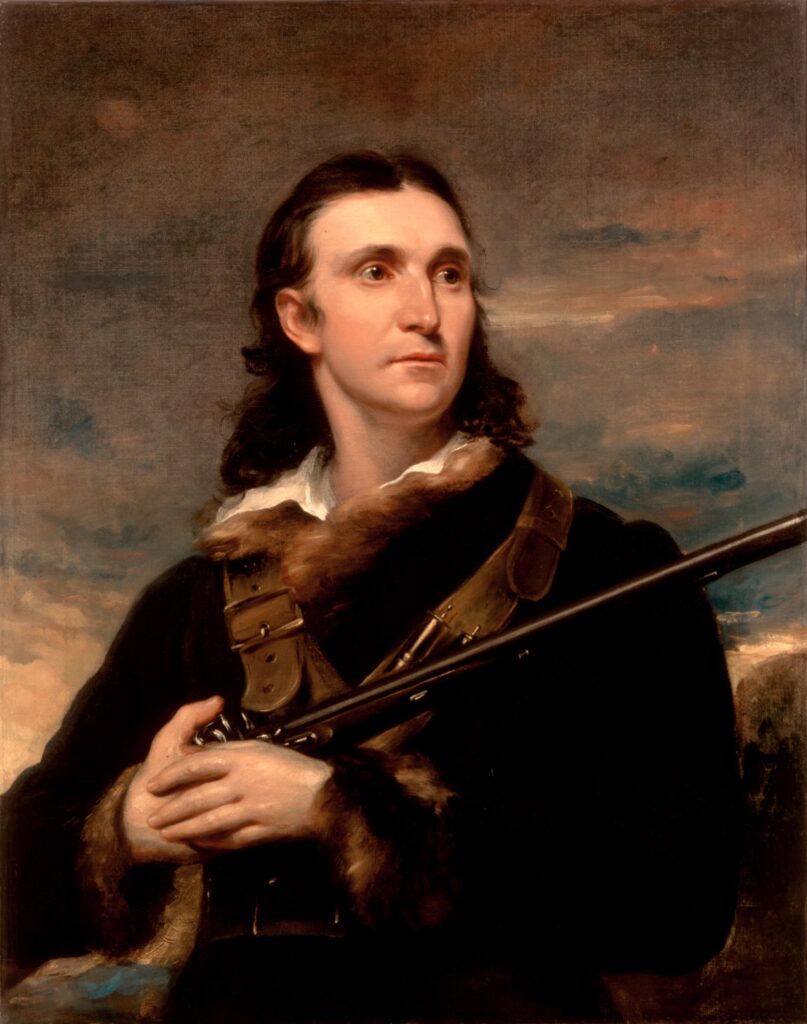
John James Audubon is one of the most renowned naturalists and ornithologists in American history, best known for his extensive study and documentation of birds.
His major work, The Birds of America, is widely considered a masterpiece of natural history illustration, showcasing his meticulous attention to detail and passion for wildlife.
Audubon’s life was marked by artistic achievements, scientific contributions, and strong connections to several American cities, including Louisville.
Early Life and Immigration to America
John James Audubon was born Jean Rabin in 1785 in Haiti to a French father and Creole mother. After the death of his mother, his father took him to France, where he was raised. His father, a naval officer and plantation owner, encouraged Audubon’s early interest in nature. As a young boy, Audubon was fascinated by birds, writing, “I felt an intimacy with them… bordering on frenzy.”
In 1803, at the age of 18, Audubon was sent to America to avoid conscription in the Napoleonic Wars and to manage his father’s property near Philadelphia. It was during this time that Audubon began to immerse himself in studying American wildlife. His passion for birds became central to his identity, and he wrote, “I wish I had wings to follow the birds.”
Settling in Louisville
In 1808, Audubon moved to Louisville with his wife, Lucy Bakewell Audubon. The couple initially settled in Louisville to start a business, operating a general store. Louisville, situated on the Ohio River, was a bustling frontier town during Audubon’s time there, providing access to the rich natural environment of the Kentucky wilderness.
Audubon’s time in Kentucky was not always smooth. His business ventures struggled, and he was eventually forced into bankruptcy in 1819. Despite these difficulties, Audubon’s connection to the natural world deepened during this period. He would spend hours exploring the nearby forests and wetlands, sketching and observing birds in their natural habitats.
Audubon later reflected on his love of Kentucky’s wilderness, writing, “The forests of America were a glorious place to me; a paradise for birds and beasts.” His Louisville years, though financially difficult, laid the groundwork for his future artistic and scientific achievements. It was in Kentucky that he first began to conceive the idea for The Birds of America, his ambitious project to document every bird species in the United States.
The Creation of The Birds of America
John James Audubon’s magnum opus, The Birds of America, is one of the most famous works of natural history in the world. The project began in earnest during the 1820s, as Audubon traveled across the United States, observing, collecting, and painting birds. His method was distinctive for the time—he depicted birds in life-size, dynamic poses, capturing their natural behavior rather than static, lifeless forms.
The Birds of America featured 435 hand-colored plates, illustrating over 700 bird species in life-size, dynamic poses.
To fund his project, Audubon spent time in Europe, where he found wealthy patrons who were fascinated by his work. The final product consisted of 435 hand-colored plates, illustrating over 700 bird species. Audubon’s dedication to accuracy and artistry set a new standard for natural history illustration. The work remains a monumental achievement in both art and science.
Audubon’s observations in The Birds of America are detailed and reflect his keen eye for both the beauty and behavior of birds. In describing the Carolina parakeet, he wrote, “The beauty of their plumage, the rapidity of their flight, and their vociferous habits render them conspicuous objects even amidst the forests in which they reside.”
Struggles and Personal Life
Despite his ultimate success, Audubon faced numerous hardships throughout his life. His financial struggles in Kentucky nearly ended his career before it began. His family often lived in poverty while he pursued his passion for studying and painting birds. His wife, Lucy, was a key figure in supporting him, both emotionally and financially. She worked as a teacher to provide for the family when Audubon’s artistic pursuits did not bring in money.
During his travels, Audubon experienced the harsh realities of frontier life, including long stretches of isolation, dangerous encounters with wildlife, and grueling physical conditions. He described these experiences in his journals, recounting one particularly treacherous winter expedition in the Mississippi River Valley: “The cold was so intense that I could scarcely draw my fingers from my pockets without being benumbed.”
In addition to his financial difficulties, Audubon also faced criticism from other naturalists. Some dismissed his work as more artistic than scientific, particularly because he used specimens to create his drawings, a practice that drew the ire of some early conservationists.
Audubon’s Scientific Contributions
Though Audubon is best known for his artistic work, his contributions to ornithology and natural science are equally significant. His meticulous documentation of bird species in The Birds of America helped establish a clearer understanding of avian diversity in North America. In addition to illustrating birds, he included detailed descriptions of their habitats, behaviors, and migrations.
Audubon was also one of the first naturalists to recognize and document the phenomenon of bird banding. In 1803, Audubon tied silver threads around the legs of Eastern Phoebes to study their migratory patterns. This early experiment in bird banding provided valuable insight into bird behavior and set the stage for future scientific research on migration.
Audubon’s writings demonstrate his dedication to both the scientific and artistic aspects of his work. In his journal, he wrote, “I have been striving to capture not just the bird, but the very life and energy within it.”
Later Years and Legacy
In his later years, Audubon continued his work as a naturalist, expanding his interests to include mammals. His final major work, The Viviparous Quadrupeds of North America, documented the mammals of the continent, although it did not achieve the same acclaim as The Birds of America.
Audubon’s health began to decline in the 1840s, and he passed away in 1851 at the age of 65. His legacy, however, endured. His name became synonymous with the conservation movement, and in 1905, the National Audubon Society was established to protect birds and their habitats, carrying on the work that Audubon had pioneered.
In Kentucky, Audubon’s legacy is particularly strong. The city of Henderson, where Audubon once lived and worked as a taxidermist, is home to the John James Audubon State Park, a museum and nature reserve dedicated to his life and work. Louisville, the city where Audubon’s career as a naturalist began, also honors his memory, recognizing his connection to the region’s natural history.
Audubon & Louisville
Louisville played a crucial role in Audubon’s development as both an artist and a naturalist. The city’s proximity to the rich wilderness of Kentucky provided the perfect environment for Audubon to study birds. He spent years observing and cataloging the bird species of the region, an effort that laid the foundation for his later work.
Though his time in Louisville was financially challenging, it was also artistically fruitful. Audubon’s early sketches and studies from this period would eventually be incorporated into The Birds of America. Louisville remained an important part of Audubon’s story, a city where he refined his skills and developed his artistic vision.
A Name Synonymous with Wildlife Conservation
John James Audubon’s influence extends beyond his artwork. His meticulous studies of bird species, habitats, and behaviors continue to serve as valuable resources for both scientists and conservationists. His work played a key role in the development of ornithology as a scientific field in North America. In particular, his recognition of the interconnectedness of species and their habitats has become a cornerstone of modern conservation efforts.
Audubon’s name is now synonymous with wildlife conservation. The National Audubon Society, one of the leading bird conservation organizations in the world, carries on his legacy, working to protect bird species and their habitats.
Audubon’s life, full of both artistic brilliance and personal hardship, remains a testament to his lasting contributions to both art and science. His detailed illustrations and observations have immortalized not only the birds of America but also his vision of the natural world.