
Mildred Jane Hill wrote the world’s most recognizable melody in a Louisville classroom and never lived to see it become one. Born in the city in 1859, she spent her career teaching, composing, and studying music — work that culminated in a simple four-line greeting song for kindergartners. Decades after her death, that tune, reworked with new words, would become “Happy Birthday to You,” sung somewhere in the world every few seconds.
Hill was more than a footnote to a birthday song, though. She was a serious musicologist who studied Black spirituals at a time almost no one in her field did, publishing research under a male pen name that reportedly influenced Antonín Dvořák’s “New World” Symphony. Her sister Patty Smith Hill, who wrote the original lyrics to their famous song, became one of the country’s most influential early-childhood educators. Their story starts, and largely stays, in Louisville.
A Musical Daughter of Louisville
Mildred Jane Hill was born June 27, 1859, in Louisville, Kentucky, the oldest of three sisters — Mildred, Patty, and Jessica. Their father was a Presbyterian minister and educator whose work took the family between Kentucky, Missouri, and Texas, but Louisville remained the sisters’ home base and, eventually, their final resting place.
Mildred learned music young and pursued it seriously, studying with the composer Adolph Weidig and building a career as a performer, teacher, and composer in Louisville’s music community. Her younger sister Patty followed a different path into education, eventually becoming principal of the Louisville Experimental Kindergarten School, an early testing ground for progressive teaching methods.
Their parents, unusually for the era, encouraged all of their children — sons and daughters alike — to pursue a profession and be self-reliant. Mildred took that charge seriously, building a career as a composer and performer at a time when few women could support themselves through music alone.
A Song Written for the Classroom
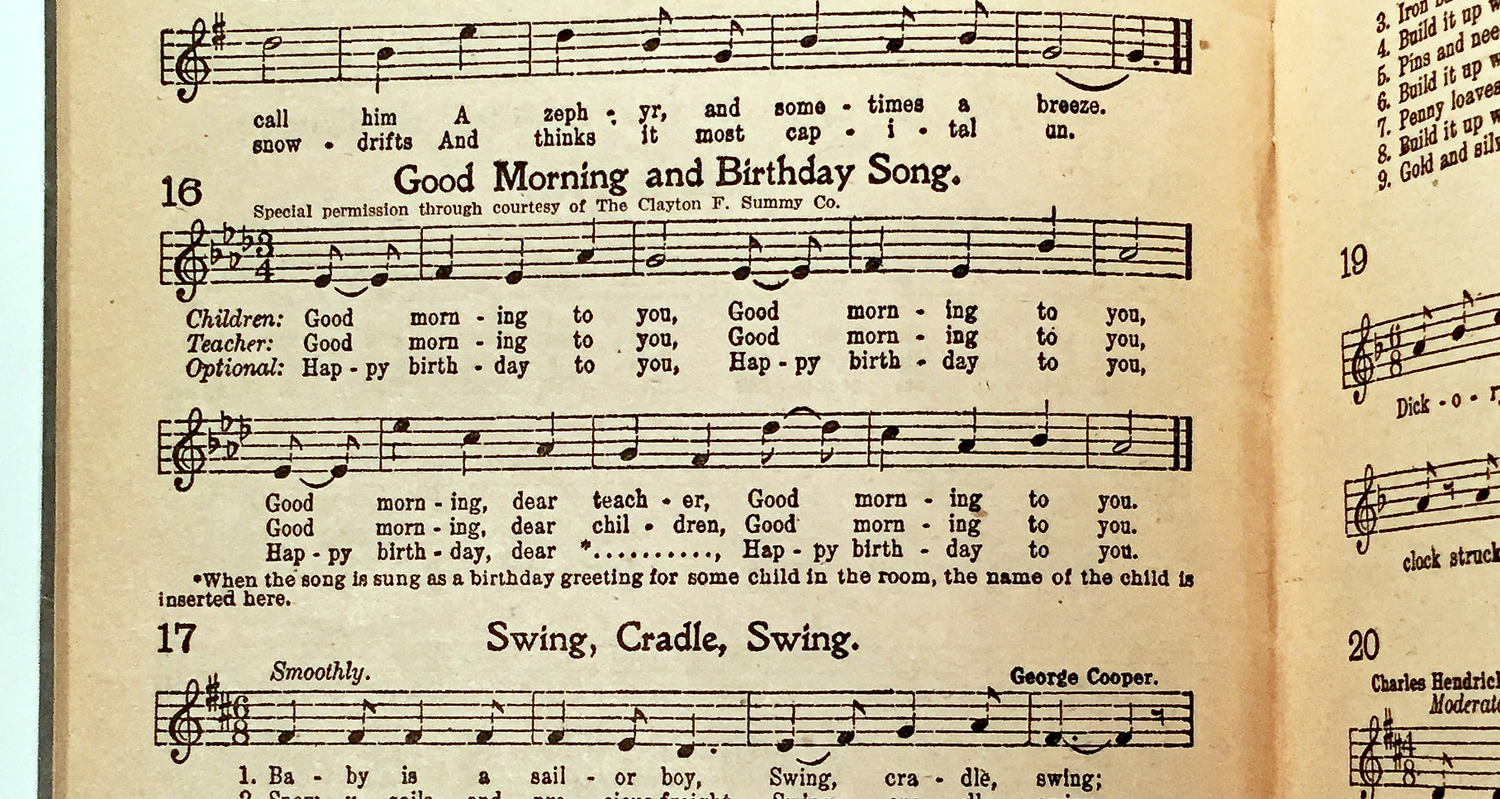
In 1893, while Patty ran the Louisville Experimental Kindergarten School, the sisters wrote a simple greeting song for teachers to sing to their students at the start of the school day. Mildred composed the melody; Patty wrote the words. They called it “Good Morning to All,” and it was published that year in a collection titled Song Stories for the Kindergarten.
The book went through more than twenty editions, and its songs were translated into French, German, Italian, Spanish, Chinese, Japanese, and Swedish. That same year, the sisters were honored at the Chicago World’s Fair for their work in progressive kindergarten education — recognition for the school, not yet for the song that would eventually eclipse everything else they did.
“Good Morning to All” was written to be sung as a greeting each morning, gathering restless children into the school day. It fit into Patty’s broader approach at the kindergarten, which served underserved and immigrant families in Louisville and emphasized freehand drawing, outdoor play, naps, and healthy snacks over the rigid, desk-bound instruction common at the time.
The Manuscript in the Archive
More than a century later, a University of Louisville archivist made a discovery that illuminated exactly how the sisters worked together. James Procell, director of the university’s Dwight Anderson Music Library, found a handwritten sketchbook tucked inside a folder labeled “Mildred Hill,” donated decades earlier by the estate of a family friend.
Mildred would compose these songs. Patty would bring them to her students, and then bring them back to Mildred to edit.
— James Procell, University of Louisville archivist
“I knew who she was and that she’d written the song. But I just assumed it contained newspaper articles that had been written about her, so I didn’t really think much about it,” Procell said of the folder, which he had passed over for years before a copyright lawsuit over “Happy Birthday” made headlines. When he finally opened it, he found a revised, easier-to-sing version of the melody in Mildred’s own hand.
The same collection holds one of Mildred’s scrapbooks, filled with newspaper clippings and research on slave and folk music. On its cover, in her own writing, are the words “Very important,” underlined three times.
A Scholar of Negro Spirituals
Composing children’s songs was only part of Mildred Hill’s musical life. She was also a serious scholar of Black American music, studying spirituals and folk songs at a time when almost no white academics took the subject seriously. To publish her research without the gender bias she expected in a male-dominated field, she wrote under the pen name Johann Tonsor.
Her 1892 article “Negro Music,” published under that pseudonym in the journal Music, argued that America’s classical composers should look to Black musical traditions to build a national style. “When our American musical Messiah sees fit to be born,” Hill wrote, “he will then find ready to his hand a mass of lyrical and dramatic themes with which to construct a distinctively American music.”
In December 1892, journalist James Gibbons Huneker brought a copy of the article to the New York apartment of Antonín Dvořák, newly arrived to direct the National Conservatory of Music. Dvořák’s own copy later turned up in a Prague museum, with the words “I love you Daddy” scrawled upside down in the margin by his young son, apparently trying to get his engrossed father’s attention.
Within days, Dvořák began sketching the themes that became his “New World” Symphony — meaning a Louisville schoolteacher’s scholarship, published under a man’s name, may have helped shape one of the most famous works in the American classical repertoire.
A Birthday at the Little Loomhouse

The Hill sisters kept a summer residence, known as Hill House, on Louisville’s Kenwood Hill. According to a Kentucky Historical Society marker dedicated at the site in 2009, it was during a birthday party at a cabin there — now part of the Little Loomhouse historic site — that Patty suggested changing the familiar “Good Morning to All” words to “Happy Birthday to You.”
The new lyrics first appeared in print in 1912, still without any credit to either sister. It would take another two decades, a wave of copyright registrations, and a series of lawsuits before Mildred and Patty Hill were widely recognized as the song’s authors at all.
Dying Before the Song Became Famous
Mildred Hill died in Chicago on June 5, 1916, at age 56, more than a decade before “Happy Birthday to You” became a fixture of American life. She was brought home to Louisville and buried beside Patty in Cave Hill Cemetery.
The song’s popularity grew through the 1920s and 1930s with no author credited at all, until a 1935 wave of copyright registrations by the Summy Company — and the out-of-court settlement of subsequent lawsuits — established the Hill sisters as its recognized authors. In September 2015, a federal judge went a step further, ruling that “Happy Birthday to You” had never been validly copyrighted at all and belonged in the public domain.
The song is now estimated to generate roughly $2 million a year in licensing and performance revenue worldwide, even after the 2015 ruling stripped away its copyright claim. Mildred and Patty Hill were posthumously inducted into the Songwriters Hall of Fame on June 12, 1996. Mildred’s manuscripts, scrapbooks, and papers remain in Louisville today, held by the University of Louisville Music Library — a fuller record, finally rediscovered, of a composer and scholar who never knew how far her simple classroom song would travel.
Sources and further reading
- Wikipedia – Mildred J. Hill
- Wikipedia – Patty Smith Hill
- University of Louisville Magazine – “Discovering the Roots of the World’s Most Popular Song”
- JSTOR Daily – “Happy Birthday to ‘Happy Birthday’ Composer Mildred J. Hill”
- Kentucky Historical Society – The Little Loomhouse Marker
- Robert Greenberg – “Music History Monday: The Fabulous Hill Sisters”