Johnny Unitas was cut by the Pittsburgh Steelers, the team closest to his hometown, before he ever threw a regular-season NFL pass. He spent the following months playing semi-pro football for six dollars a game and working construction, a detour that could easily have ended his career before it started. Instead, a four-year stint at the University of Louisville and a near-accidental tryout with the Baltimore Colts turned him into the quarterback who, more than almost anyone else, is credited with making pro football a national obsession.
Too Small for Notre Dame
Unitas was born May 7, 1933, and grew up in Pittsburgh, attending St. Justin’s High School, where he starred at quarterback well enough to draw interest from Notre Dame. The Fighting Irish coaching staff ultimately passed on him, judging him too small and too light for major college football. The University of Louisville offered him a scholarship instead, and Unitas headed south to a program with a far lower national profile than the one that had turned him away.
He grew into his frame during his four years as a Louisville Cardinal, eventually reaching 6-foot-1 and 190 pounds, and put together a college career that included 245 completions, 3,139 passing yards, and 27 touchdown passes, solid production for a program that was never in serious contention for the sport’s biggest honors during his time there.
Louisville’s program in the early 1950s did not have anywhere near the resources or national visibility of the major conference schools, which meant Unitas developed largely outside the scouting radar that shaped how NFL teams evaluated quarterback prospects at the time. That relative anonymity is part of why his low ninth-round draft selection in 1955 didn’t strike anyone as especially surprising, even though it would later look like one of the more significant scouting misses in league history.
Cut, Then Six Dollars a Game
The Pittsburgh Steelers drafted Unitas in the ninth round of the 1955 NFL Draft, a low selection that reflected how little national attention his college career had generated. The Steelers cut him before the season began without giving him a real chance to compete for a roster spot. Unitas returned to Pittsburgh, took a job in construction to pay the bills, and played semi-pro football for the Bloomfield Rams for six dollars a game, a level of competition and pay about as far from the NFL as a serious football player could get.
“I never doubted myself. I just needed somebody to give me a chance.”
— Johnny Unitas, on the period after his release by the Steelers
The chance came in 1956, when the Baltimore Colts, under head coach Weeb Ewbank, signed Unitas after hearing about the Pittsburgh sandlot quarterback with the strong arm. It was an unglamorous path into the league, but it put him in the right building at the right time.
Accounts vary on exactly how the Colts first learned about Unitas, but the most commonly told version involves Ewbank’s staff getting a tip about a local sandlot quarterback worth a look, a low-cost, low-risk signing that turned into one of the most consequential roster decisions in NFL history. Unitas made the team in training camp on a tryout basis with no guarantees, a stark contrast to the securely drafted rookies he would eventually be compared to as his career unfolded.
The Greatest Game Ever Played
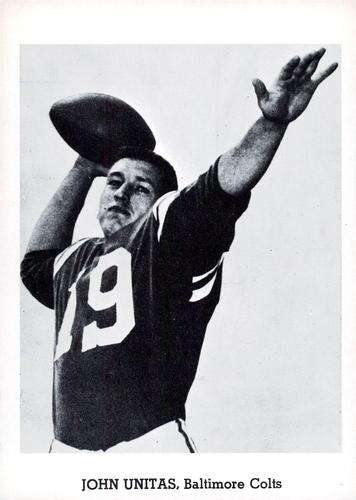
By 1957, his first full season as Baltimore’s starter, Unitas led the NFL in passing yards with 2,550 and touchdown passes with 24, establishing himself as one of the league’s premier quarterbacks within two years of playing sandlot ball for beer money. His defining moment came on December 28, 1958, when the Colts faced the New York Giants in the NFL Championship Game at Yankee Stadium.
The Colts won 23-17 on an Alan Ameche touchdown in what became the first sudden-death overtime game in NFL history. The game was broadcast nationally by NBC and is widely credited with sparking professional football’s surge in popularity through the 1960s, earning it a lasting nickname among football historians and journalists: “the greatest game ever played.” Unitas’s poised, methodical performance under pressure in that overtime drive became the signature moment of his career and a touchstone for the sport’s television era.
The Golden Arm
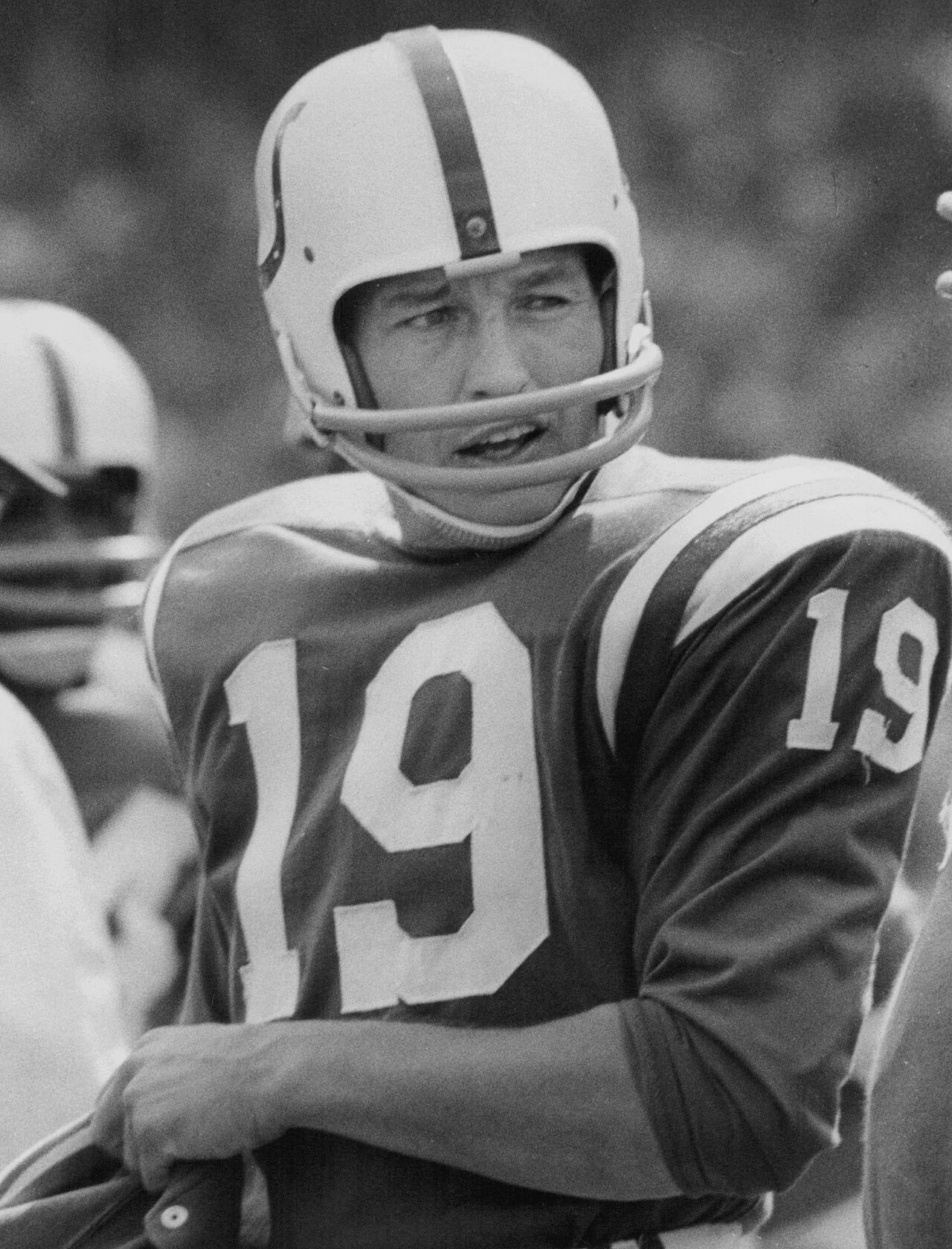
Unitas played for the Colts from 1956 to 1973, setting numerous NFL passing records along the way and earning the nickname “The Golden Arm.” He was named the league’s Most Valuable Player three times, in 1959, 1964, and 1967, made ten Pro Bowl appearances, and was selected first-team All-Pro five times. He helped lead the Colts to NFL championships in 1958, 1959, and 1968 under the pre-merger format, and to a Super Bowl V title after the AFL-NFL merger.
His path from a rejected Steelers draft pick to one of the most decorated quarterbacks in league history became a template for the underdog-makes-good narrative that pro football has returned to repeatedly ever since, and the fact that his college years happened in Louisville rather than at a football powerhouse only reinforced the story of a player who succeeded almost entirely on merit discovered late.
A Louisville Legacy
Louisville has continued to claim Unitas as one of its own despite his fame being built almost entirely in Baltimore, largely because his college years shaped the player who went on to redefine the quarterback position. Since 1987, the Johnny Unitas Golden Arm Award has been presented annually to the top senior college quarterback in the country, a tradition run out of Louisville that keeps his name attached to the sport’s quarterback development pipeline decades after his playing career ended.
Unitas died in 2002, and tributes at the time consistently returned to the same arc: a quarterback too small for Notre Dame, cut by his hometown team, playing sandlot football for six dollars a game, who went on to author the single game most credited with turning professional football into America’s dominant sport.
Football historians revisiting his career have consistently pointed to the same irony: the scouting apparatus of the mid-1950s, built around major-conference visibility and pre-draft reputation, nearly let one of the sport’s most important players slip through entirely. Had the Colts not heard about a sandlot quarterback playing for six dollars a game in Pittsburgh, or had Unitas simply given up on football after his release from the Steelers, the trajectory of professional football’s rise to national popularity in the following decade might have looked very different.
Sources and further reading
- Childhood, Notre Dame rejection, and University of Louisville career — Wikipedia and Britannica
- Pittsburgh Steelers release and semi-pro years with the Bloomfield Rams — johnnyunitas.com and EBSCO Research Starters
- The 1958 NFL Championship Game and its cultural impact — the Pro Football Hall of Fame and New World Encyclopedia
- Career records and MVP honors — Britannica and the Kentucky Pro Football Hall of Fame
- Johnny Unitas Golden Arm Award — johnnyunitas.com