
Every year in late May, a few hundred kids gather in a Washington, D.C. hotel ballroom, spend a week spelling words most adults have never heard, and stand alone at a microphone in front of a national television audience. The whole tradition traces back to a hometown newspaper contest here in Louisville, a $500 prize in gold coins, and eleven-year-old Frank Neuhauser spelling “gladiolus” correctly in June 1925.
Nine Kids and a Newspaper Contest
In 1925, The Courier-Journal decided to take the kind of local spelling contest that dozens of American newspapers already ran and turn it into something bigger. The paper organized a citywide bee, then reached out to other papers around the country and proposed a national final: each participating newspaper would send its own local champion to Washington, D.C., where the finalists would spell head-to-head for a national title.
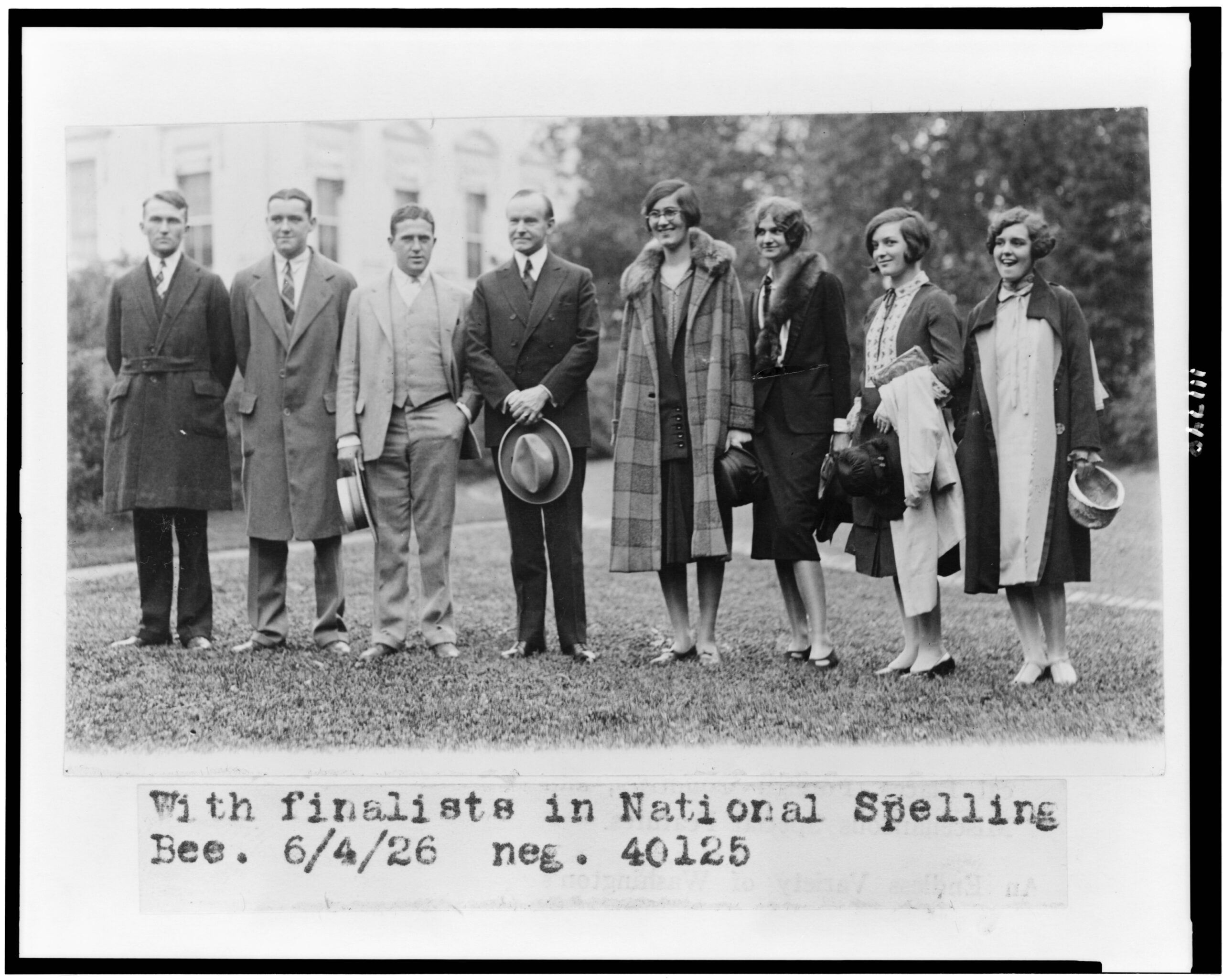
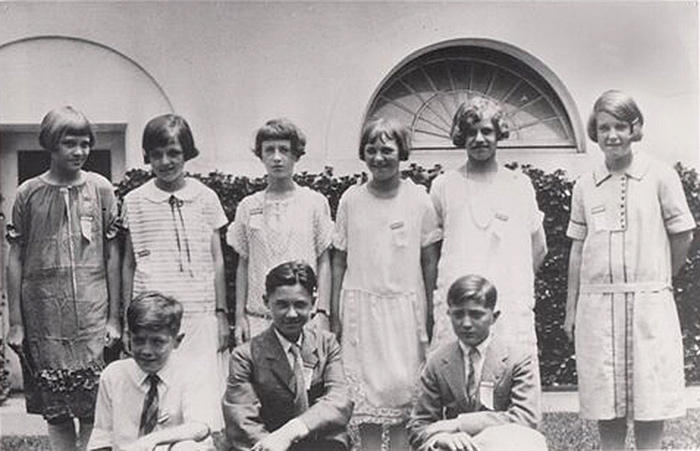
Nine contestants made the trip that first year — six girls and three boys, representing cities from Detroit to Houston to South Bend, Indiana — whittled down from a reported two million schoolchildren who had entered contests at the local level. It was a small enough group that before the competition even started, all nine were invited to meet President Calvin Coolidge at the White House.
Gladiolus
The first National Spelling Bee ran ninety minutes on June 17, 1925, at the old National Museum building near the Smithsonian. The field narrowed fast: Almeda Pennington went out first on “skittish,” then Mary Coddens on “cosmos,” Loren Mackey on “propeller,” Patrick Kelly on “blackguard,” and Dorothy Karrick on “statistician.” Mary Daniel of Hartford took fourth after missing “valuing,” and Helen Fischer of Akron took third after missing “moribund.”
That left two: Frank Neuhauser, an eleven-year-old from Louisville, and Edna Stover of Trenton, New Jersey. Both were given the word “gladiolus.” Stover spelled it with a “y” where an “i” belonged and took second place. Neuhauser spelled it correctly — fittingly, since gladiolus was a flower he had raised himself as a boy — and became the first National Spelling Bee champion.
He won $500 in gold pieces, and when he got home, Louisville gave him a parade and a bouquet of gladioli. His classmates chipped in for a bicycle.
A Local Boy Made Good
Neuhauser wasn’t just representing Louisville — he was born and raised here, the son of German American parents. His father, a stonemason, drilled him on spelling on weekends when the weather kept them indoors, and Frank prepared for the national contest by copying pages of the dictionary into a blank notebook.
He went on to earn an engineering degree from the University of Louisville in 1934, then a law degree from George Washington University, and spent most of his career as a patent attorney for General Electric, eventually training generations of GE’s patent lawyers in Washington.
Neuhauser stayed connected to the Bee for the rest of his long life, showing up as a guest of honor at national finals decades later and appearing in the 2002 documentary Spellbound. Asked to compare his own era to the modern competition, which by then drew hundreds of contestants instead of nine, he was characteristically modest about it.
It was a lot easier back then… I’d never make it now.
— 1925 champion Frank Neuhauser, in the documentary Spellbound (2002)
Neuhauser died in 2011 at 97, still remembered, as The New York Times put it in his obituary, as “a speller’s speller.”
Scripps Takes the Word
The Courier-Journal kept running the National Spelling Bee through the rest of the 1920s and all through the 1930s, growing it a little each year even as the country sank into the Great Depression.
The first-place prize, $500 in the inaugural year, doubled to $1,000 in 1926, then dropped back down to $500 during the leanest Depression years before climbing back up. By the end of the 1930s the contest had outgrown what one regional newspaper could reasonably run on its own.
In 1941, The Courier-Journal handed the Bee off to the Scripps Howard Broadcasting Company — now the E.W. Scripps Company — which has run it as a not-for-profit educational program ever since. The contest went dark for three years, from 1943 to 1945, during World War II, the only gap in its history until the COVID-19 pandemic forced a second cancellation in 2020, seventy-five years later.
The Bee Today
The event Neuhauser won in an afternoon now takes the better part of a week. What started as a single day of competition became a two-day format in 1958, then three days in 2001, as the field grew from nine finalists to well over 200.
Spellers now work through written vocabulary tests and multiple oral rounds before the finals, sponsored by more than 175 newspapers, media outlets, and organizations across the United States and abroad — not just American schoolchildren, but competitors from the Bahamas, Canada, Ghana, India, Jamaica, and beyond.
The prize has grown along with the field. Neuhauser’s $500 in gold looks modest next to the $50,000 cash prize, engraved trophy, and reference-library packages awarded to champions today.
Television found the Bee in the 1990s, first through ESPN and later a prime-time run on ABC, turning what had been a regional newspaper promotion into a genuine national spectacle, complete with breakout young stars: Zaila Avant-garde became the first African American champion in 2021, and in 2019 the competition ran out of hard enough words entirely, crowning eight co-champions at once.
Louisville’s Fleur de Bee
A hundred years on, Louisville still sends spellers to the national contest it invented. The Louisville Free Public Library now hosts the local qualifying round under a name that would make Victor Hammer smile: the Fleur de Bee, a nod to the fleur-de-lis at the heart of the city’s own history. Recent years have sent Louisville-area kids like Meyzeek Middle School’s Zachary Rara deep into the national rounds, more than two thousand miles and a full century removed from the afternoon a Louisville stonemason’s son spelled his way into gold coins, a parade, and the record books.
Sources and further reading
- Origins, format history, and prize records — Wikipedia’s “Scripps National Spelling Bee” and “1st Scripps National Spelling Bee”
- Frank Neuhauser’s biography, University of Louisville degree, and career — Wikipedia and his 2011 obituaries in The New York Times and The Washington Post
- The Spellbound quotation as reported in coverage of the 2002 documentary — IMDb
- Recent Louisville-area competitors — WHAS11 and Spectrum News 1 Louisville coverage of the Fleur de Bee regional competition