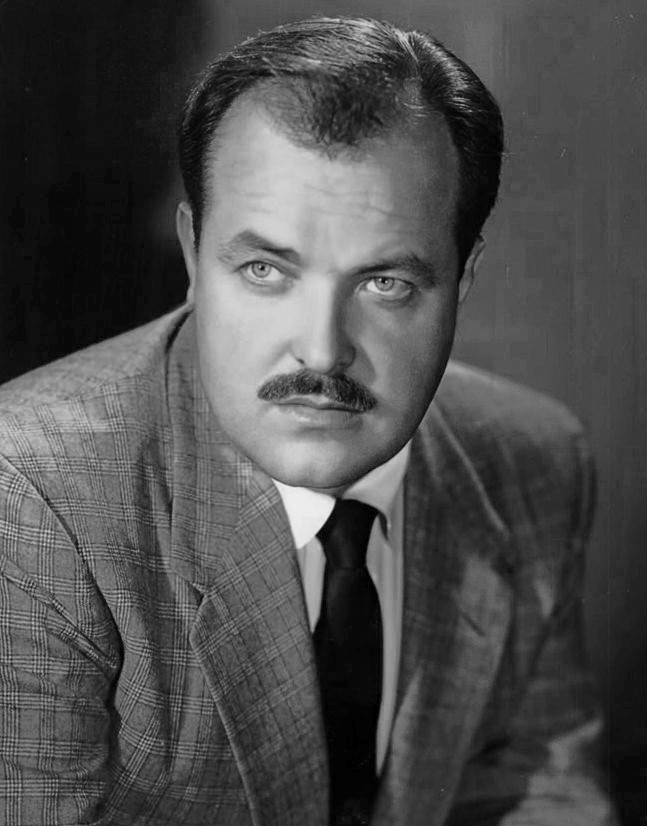
Long before he was a fat, cigar-chomping television detective or the booming, unseen narrator warning cartoon moose and squirrel of impending doom, William Conrad was a baby in Louisville, Kentucky, growing up underneath the flicker of his father’s movie projector.
He would go on to play more than 7,500 radio roles, originate Marshal Matt Dillon on the radio version of Gunsmoke, menace Burt Lancaster in one of film noir’s defining openings, and finally become a household name playing overweight, wisecracking crimefighters on Cannon and Jake and the Fatman. He almost never mentioned Louisville. He barely remembered it. But it is where his story starts.
Born Above the Marquee
John William Cann Jr. was born in Louisville on September 27, 1920, to John William Cann and Ida Mae Upchurch Cann. His father worked as a motion picture exhibitor — a theater owner and operator — a job he had already taken up by the time his son was a toddler.
Conrad rarely dwelled on the specifics of his Kentucky birth in interviews, but he was direct about what growing up in movie houses did to him. “It all came about so naturally that I was never consciously aware of my desire for ‘showbiz’ until I had fallen right in the middle of it,” he said in a 1971 interview.
My father, from the time I was two years old, had been a motion picture exhibitor, and I suppose it never occurred to me to do anything else but be an actor.
William Conrad, 1971
Census records place the family in Olustee, in Jackson County, Oklahoma, by 1930, running a picture show there before the Canns eventually resettled in Southern California, where young William finished growing up.
By the time he was a teenager, the family had settled near Los Angeles. Conrad attended Excelsior Union High School in Norwalk, California, then enrolled at Fullerton College as a literature and drama major.
It was there, while still a student, that he talked his way into a job at Los Angeles radio station KMPC — writing, announcing, and eventually acting — and changed his professional name from Cann to Conrad.
A Voice Built for Radio
Conrad discovered he had an unusual instrument: a bass voice with a three-octave range, developed in part through singing lessons he took in his spare time at KMPC.
World War II interrupted his rising radio career. He enlisted and trained as a fighter pilot in the United States Army Air Forces, was commissioned in 1943, and married his first wife, June Nelson, the same day. He left the service in 1945 with the rank of captain, having spent part of the war as a producer-director for the Armed Forces Radio Service.
Back in Los Angeles after the war, Conrad became one of the busiest character voices in American radio. By his own estimate he eventually appeared in more than 7,500 broadcast roles — on Escape, Suspense, Dragnet, The Adventures of Sam Spade, Fibber McGee and Molly, and dozens of other series, sometimes several in a single day.
He worked so often that CBS occasionally had him credited under the pseudonym “Julius Krelboyne” so his real name wouldn’t appear on too many competing shows in the same week.
“We’re Gonna Kill the Swede”
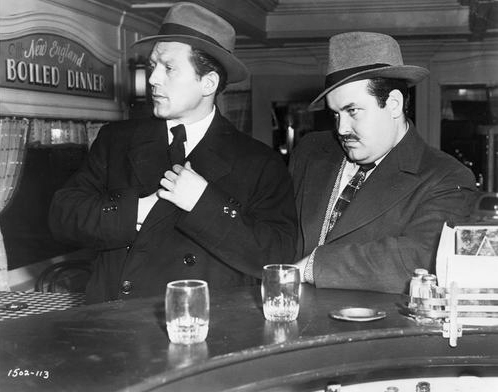
Conrad’s film career opened with one of the coldest scenes in American film noir. In The Killers (1946), adapted from the Ernest Hemingway short story, Conrad and Charles McGraw play two hired guns who walk into a small-town diner looking for a former boxer known as “the Swede,” played by Burt Lancaster in his screen debut.
“We’re gonna kill the Swede,” Conrad’s character tells the terrified counterman. “He never had a chance to do anything to us, he never even seen us. We’re killin’ him for a friend.” Conrad disappears from the film for nearly an hour afterward, and reviewers at the time singled him out anyway.
The same quiet menace followed him through Body and Soul (1947), Sorry, Wrong Number (1948), Cry Danger (1951), and The Racket (1951), his sixth and final film noir, in which the New York Times wrote that he “play[ed] the heavy with unctuous delight.”
Dodge City’s Marshal — On the Radio, Not the Screen
In 1952, Conrad won the role that would define his early career: Marshal Matt Dillon on CBS Radio’s Gunsmoke. Producers had initially passed him over because his voice was already everywhere on the radio dial, but his audition was too good to ignore.
He voiced Dillon for the show’s full nine-year run, even writing one 1953 episode himself. When Gunsmoke made the jump to television in 1955, CBS executives declined to bring Conrad along despite fan campaigns urging them to reconsider.
By his own account, network brass thought he was too heavy and too bald to play a leading man on camera, so James Arness got the part instead. For six overlapping years, two different actors were playing the same Kansas marshal: Arness on television, Conrad on the radio nobody watched him on.
From the Director’s Chair
Rejected as a screen leading man, Conrad simply moved behind the camera. By the mid-1960s he was producing the detective series 77 Sunset Strip for Warner Bros. Television. He recalled how his directing career suddenly expanded, in a 1966 interview with the Los Angeles Times:
I was producing 77 Sunset Strip and my contract expired on a Friday. I was putting my junk in my car when I was told Jack Warner was calling me. I thought one of the guys was putting me on. But it was really Mr. Warner, who said, ‘I want you to act, to direct, to produce — do anything you want.’
William Conrad, 1966
Conrad went on to direct several more feature films for Warner Bros. and was named an executive producer for Warner Bros. Television.
His directing career had actually started years earlier, in the late 1950s, when he helmed his first television episode for Ziv Studios, one of the era’s biggest independent producers. His debut came on an episode of “Target,” hosted by veteran screen star Adolphe Menjou.
He then negotiated to perform in five episodes of the Western series Bat Masterson on the condition that he could direct five episodes of his own. Conrad retired from acting after just one of those appearances and kept directing instead — including episodes of the television version of Gunsmoke, the very show that wouldn’t let him act in front of its cameras.
He also directed three feature thrillers — Two on a Guillotine, My Blood Runs Cold, and Brainstorm — all released in a single year, 1965, and kept a hand in performing, lending his voice to Jay Ward’s Rocky and Bullwinkle and “Dudley Do-Right,” billed as “Bill Conrad,” and narrating The Fugitive from 1963 to 1967.
Frank Cannon Makes Him a Star
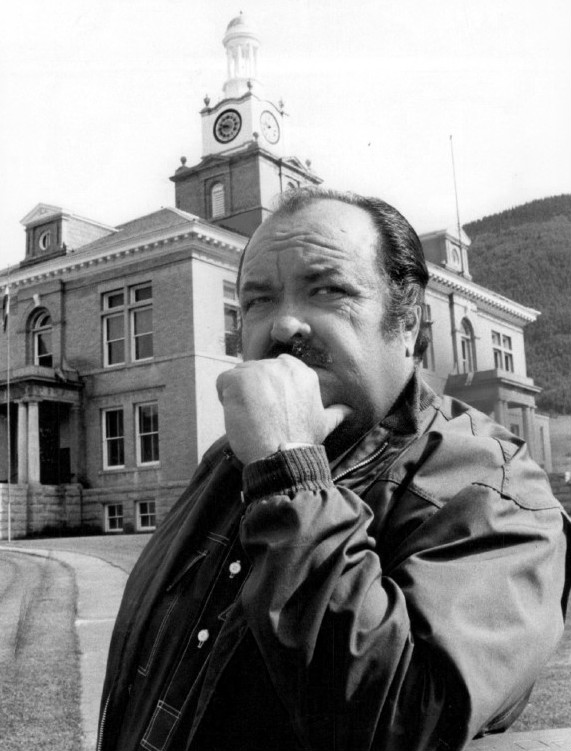
In 1971, at age 50, Conrad finally became a leading man — not despite his weight, but because of it. Cannon cast him as Frank Cannon, a retired police detective turned private investigator who, in Conrad’s own description, was “a non-glamorous, rather portly private eye who has a weight problem and doesn’t always outwit the villain.”
The show ran on CBS from 1971 to 1976 and made Conrad, at 230 to 260 pounds, an unlikely action star, taking down suspects with chokeholds, bear hugs — he once subdued guest villain Leslie Nielsen that way — and sheer bulk.
Conrad won “Most Promising New Male TV Star” honors after the show’s first season, becoming, at 50, one of television’s most unlikely new leading men.
The Weight Watchers Gag
Conrad’s size became part of the running joke around Cannon. He recounted one especially strange brush with it in 1973:
I heard that Weight Watchers had banned its members from watching the show, but it turned out to be a gag. The publicist for Weight Watchers did call and suggest that I have lunch with their president. I said sure — if I could pick the restaurant.
William Conrad, 1973
Despite the show’s popularity, Conrad never fully warmed to the material. “Most of television is crap. Cannon was crap,” he said not long after the series ended. “I was delighted to see it cancelled.”
Whatever his private verdict, Cannon had made him, at last, a leading man on the medium that had once rejected him.
The Fatman’s Final Case
Conrad returned to series television in 1981 as detective novelist Rex Stout’s Nero Wolfe, then landed his second long-running hit after a guest appearance as a hard-nosed prosecutor on Matlock.
That one-off role was popular enough that producers built an entire series around it: Jake and the Fatman, which cast Conrad as Honolulu district attorney Jason “Fatman” McCabe from 1987 to 1992.
Conrad grew frustrated with the show’s writing — “I want to get out. When I say what I think, I get in trouble,” he said at one point — but stayed for its full five-season run. Executive producer Dean Hargrove later remembered him fondly: “[Conrad] could be irascible and very blunt and direct in his opinions, but underneath it all he was a very decent, thoughtful, and considerate gentleman.”
William Conrad died of a heart attack on February 11, 1994, in Los Angeles. He was 73. “You get a guy like Bill, he simply wasn’t concerned about whether he was successful or not,” his widow, Tippy Conrad, said afterward. “He just had a strong notion about what he wanted and he went ahead and did it.”
He was inducted into the National Radio Hall of Fame in 1997, three years after his death — recognition for the medium that had made him, decades earlier, the voice of a Kansas marshal that television wouldn’t let him play on camera.
Legacy of a Louisville-Born Voice
Conrad spent almost none of his life in Kentucky — his family had moved on by the time he was old enough to remember much of it. But Louisville was where the story began: a toddler in a projection booth, watching light flicker across a screen, in a house run by a man who couldn’t imagine any other trade for his son.
Seventy years and 7,500 radio roles later, neither could William Conrad.
Sources and further reading
More from Louisville
Ned Beatty
Another Louisville-born character actor who built a career playing the unforgettable supporting role.
Jack Warden
A third Louisville actor whose face you know even if the name takes a second, working steadily across decades of film and television.
Famous People from Louisville
Conrad’s place among the city’s long list of actors, journalists, and athletes.