
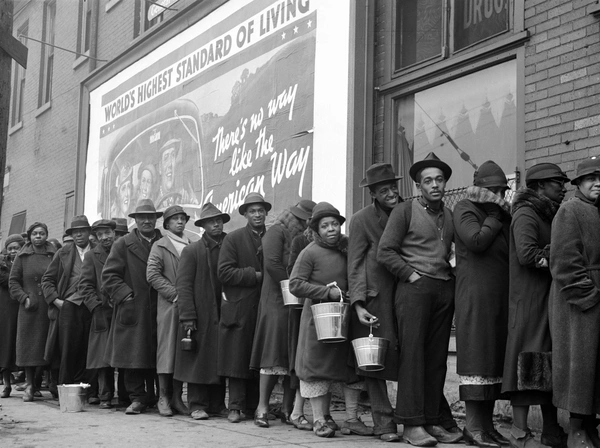
In February 1937, Margaret Bourke-White photographed a Red Cross relief line in Louisville, in front of a billboard promising the American Dream.
It became one of the most reproduced news photographs of the twentieth century.
The photograph shows eighteen people, mostly Black men and women, standing in line with baskets and pails. They are waiting for food, water, and medicine at a Red Cross relief station.
Behind them looms a billboard: a smiling white family of four and their dog, drive through the countryside under two lines of text. “World’s Highest Standard of Living,” the top line reads. Below it, smaller: “There’s No Way Like the American Way.”
Bourke-White took the picture near 13th and Broadway, in Louisville’s California neighborhood, during the catastrophic Ohio River flood that put most of Louisville underwater. It ran in Life magazine two weeks later. It has been reproduced, exhibited, sampled, and argued over ever since, almost always stripped of its context.
- Today, the photograph remains under copyright. That keeps the image protected in the United States until 2033, so we can’t reproduced here. But you can see it online at the Museum of Modern Art’s collection page and the Art Institute of Chicago.
- A rarely seen alternate angle that Bourke-White took within moments of her famous shot is shown above (from the Life Picture Collection).
A City Underwater
The flood that produced the photograph is its own story, and one of the worst natural disasters in American history. Sixteen inches of rain and sleet fell on the Ohio Valley over eleven days in January 1937. The river kept rising through the month, and on January 27 it crested at 460 feet above sea level, roughly 40 feet above its normal level.
Almost 70 percent of Louisville went underwater. Floodwaters reached 10 feet deep downtown and in the West End. About 175,000 residents were forced from their homes. That was about half of all Louisvillians in what was then a city of fewer than 320,000 people.
The flood wiped out the neighborhoods of Shippingport and The Point entirely. Total damage across Kentucky came to roughly $250 million, more than $5 billion in today’s money.
Nearly 400 people died across the five flooded states, with the toll in Louisville alone estimated at around 190.
The American Red Cross called it the worst disaster in the organization’s history to that point. The NAACP contacted the United States Coast Guard directly, after receiving reports that Black residents were being passed over for rescue.
A One-Hour Notice
Margaret Bourke-White was in Washington, DC, finishing her coverage of Franklin D. Roosevelt’s second inauguration when the flood broke into national news. Life’s editor, Shaw Billings, gave her an hour to figure out how to get to Louisville. She caught the last flight in and landed at Bowman Field just before the airfield itself went underwater.
A Louisville realtor and amateur photographer named Corwin Short met her at the airport. Mayor Neville Miller had asked him to guide her through the flooded city. The two of them hitchhiked into town by raft and rowboat, photographing as they went.
I thumbed rides in rowboats and once on a large raft. These makeshift craft were bringing food packages and bottles of clean drinking water to marooned families and seeking out survivors.
Margaret Bourke-White, in her 1963 memoir, Portrait of Myself
Bourke-White slept at the Old U.S. Customshouse and Post Office downtown, which had become a makeshift press headquarters for the flooded-out Courier-Journal and Louisville Times.
She photographed the newspaper staff working by kerosene lamp after the power failed. At St. Paul’s Episcopal Church, she photographed pews stacked with canned food waiting for Red Cross distribution.
Churchill Downs’ clubhouse had been turned into a shelter, and she photographed Jim Lawhorn there. He was a man in his nineties who had been born enslaved and was now a flood refugee. The picture struck readers almost as hard as the breadline shot.
Short, the amateur photographer, took more than 100 photographs himself during the flood, including several of Bourke-White at work. He photographed her perched with her camera on the roof of a car, crossing a pontoon bridge, and riding in a rowboat. He donated the full set to the University of Louisville in 2002, and they were first exhibited in 1987.
The Billboard’s Real Story
The billboard was not a local one. It belonged to a national advertising campaign run by the National Association of Manufacturers, a pro-business trade group founded in 1895.
By the mid-1930s, NAM had declared open opposition to the New Deal. Business Week reported at the time that the group had effectively declared “war” on the Roosevelt administration, opposing unions, federal taxes, and regulation.
Roosevelt won reelection in a landslide in 1936 despite NAM’s efforts, and the group’s public tone softened afterward. Its spending did not.
NAM increased its public relations budget almost twenty-two-fold, from $36,500 to $793,043. By 1938, that money had funded an estimated 60,000 billboards nationwide, plus radio programs, newsreels, and library materials. Life’s own original 1937 caption for Bourke-White’s photo called the billboard part of a “propaganda campaign.”
The federal government’s own Farm Security Administration sent photographers to document the same billboard campaign elsewhere in the country. One of those photographers, Dorothea Lange, photographed another billboard from the same campaign on U.S. Highway 99 in California, two months after Bourke-White’s Louisville trip.
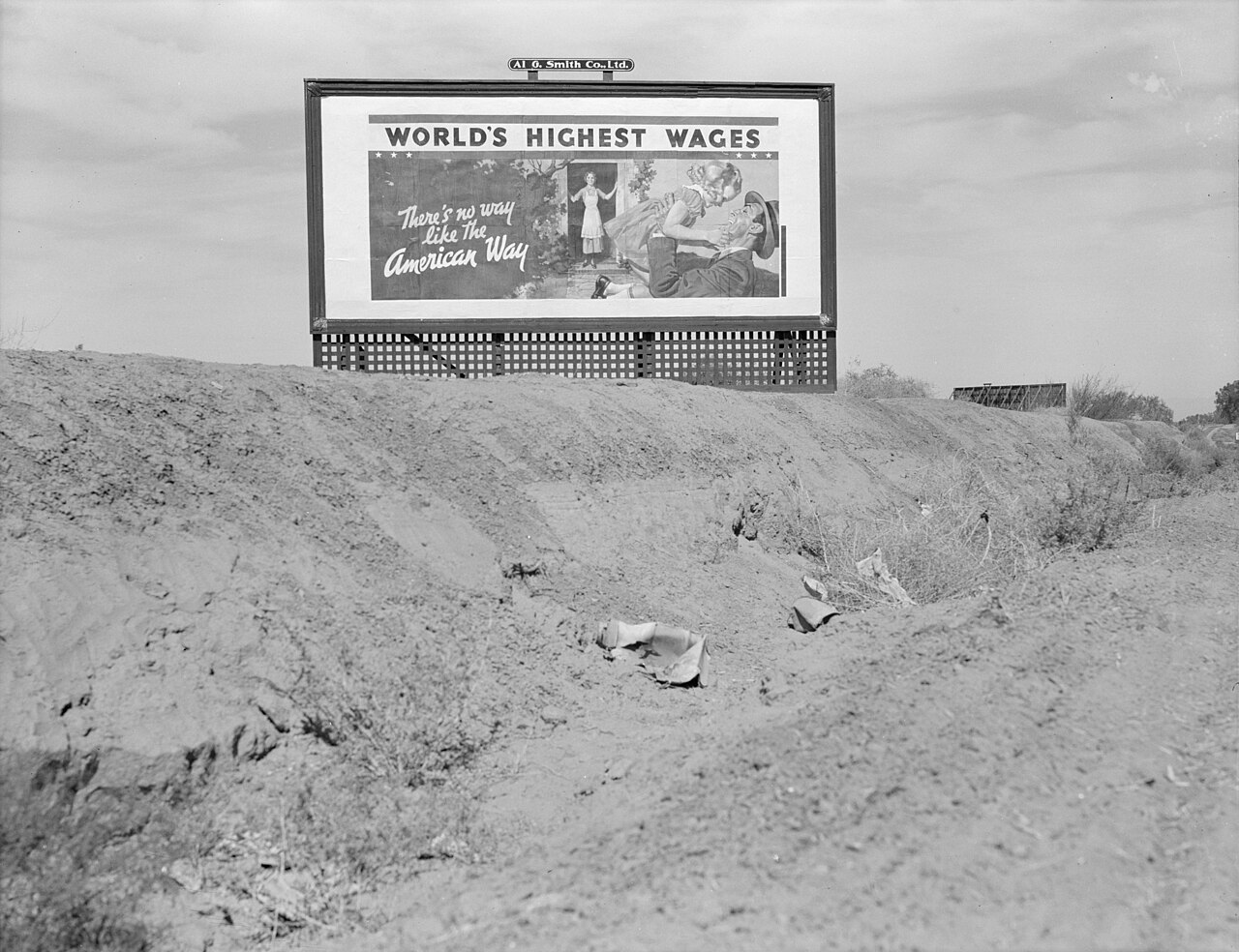
Scholar James Guimond has called Bourke-White’s Louisville photograph “the most famous picture of the NAM billboards.” She was not part of the FSA project, though, and never intended the photo as a document of the ad campaign itself. She was documenting a flood. The billboard just happened to be standing there.
More Than One Frame
The famous photo isn’t the only one Bourke-White took of the relief line. Researchers have identified at least four separate exposures of the same scene, shot from different angles and distances. They are part of a larger series of more than twenty flood photographs she made in Louisville, of which Life published only eight in 1937.
The published version shows 18 people in line. An unpublished variant, cataloged as “Louisville Flood Red Cross Relief Station, Louisville, K.Y.,” was shot from a lower angle off to the side and shows 21 people.
Two other unpublished frames, both titled some version of “Fresh Water Line, Flood Victims, Louisville,” pull back further still. They show the line stretching out of frame in both directions: winding around a street corner on one side, and disappearing into the relief station itself on the other.
Brian Piper, a curator at the New Orleans Museum of Art, has studied one of the unpublished variants the museum acquired in 1979. He has noted that the wider version “gives a sense of perspective and lets us know just how long the queue of displaced people extended down the street.” The tightly cropped published photo doesn’t reveal that.
Also sometimes overlooked is that the people waiting in the line are fairly well dressed, with hats, neckties, and warm coats.
Prints and negatives from the series are now scattered across several institutions. They include the Life Picture Collection, Cornell’s Herbert F. Johnson Museum of Art, the New Orleans Museum of Art, and the International Center of Photography in New York, among others.
A print of the Red Cross relief station variant sold at Sotheby’s in 2020, as part of the Ginny Williams Collection.
The Woman Behind the Camera
Bourke-White was already one of the best-known photographers in America by the time she flew to Louisville.
Born in New York in 1904, she studied under Clarence White, a founder of the Photo-Secession movement. She opened a commercial photography studio in Cleveland in 1927, and her industrial images for the Otis Steel Company made her name at 24.
Henry Luce hired her for his new Fortune magazine. There, she became the first Western photographer granted official access to document Soviet industry, under the country’s first five-year plan
A 1934 Fortune assignment covering the Dust Bowl pushed her toward a more people-centered documentary style. In 1936, she collaborated with writer Erskine Caldwell on the book You Have Seen Their Faces, documenting poverty in the American South.
That same year, Luce made her one of four founding staff photographers for his newest magazine, Life. Her photograph of the Fort Peck Dam in Montana ran on the cover of the first issue. That made her both the magazine’s first female photojournalist and the photographer of its very first cover.
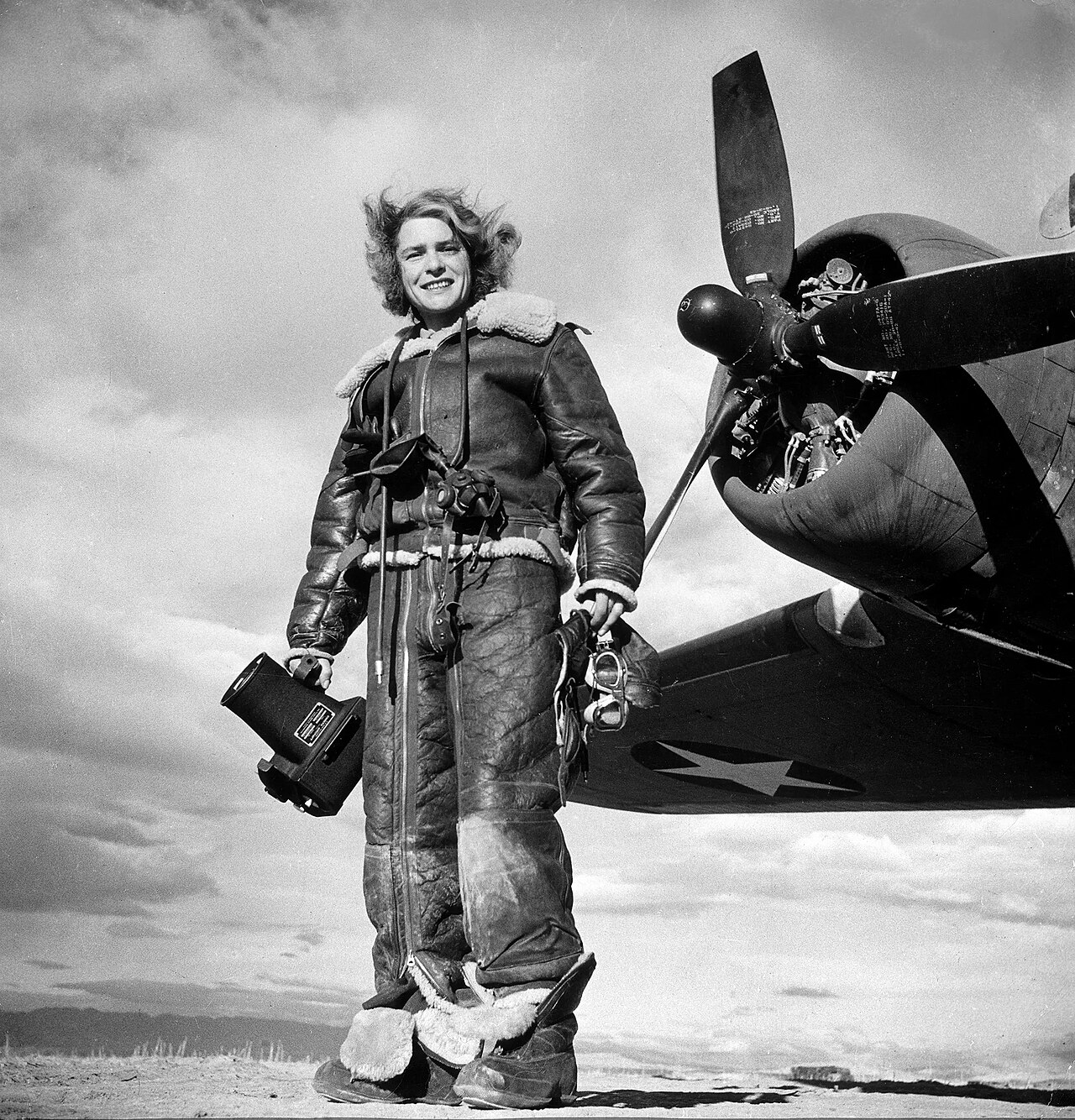
The Louisville flood came less than four months into that job. It would not be her last brush with historic upheaval. During World War II, she became the first American female war correspondent. She covered the Italian campaign, the siege of Moscow, and the Allied crossing of the Rhine into Germany. Her photographs of the newly liberated Buchenwald concentration camp were among the first such images American readers ever saw.
She kept working until Parkinson’s disease, first diagnosed in 1953, ended her career. She died in Stamford, Connecticut, in 1971.
A Symbol That Outgrew Its Story
Within weeks, the photograph had a life of its own. The Museum of Modern Art exhibited it in March 1937, barely a month after publication, under the title “The Flood Leaves Its Victims on the Bread Line.” It has since been shown at the National Gallery of Canada, the Baltimore Museum of Art, the Metropolitan Museum of Art, and the Museum of Fine Arts, Boston, most recently in 2023.
The image itself contains no visual cue that it depicts a flood: no water, no wreckage. Because of that, it has been endlessly recontextualized as a general symbol of Great Depression poverty, rather than a specific record of a Louisville disaster.
A 1992 art-history survey captioned it as showing “the unemployed on a breadline during the Depression.” An Australian news outlet used it to illustrate a 2008 opinion piece on the subprime mortgage crisis. Nazi propaganda minister Joseph Goebbels reportedly reprinted it during the war, with a caption mocking the American Way slogan directly: “Thank God, we have a better way.”
Bourke-White exposes the gap between propaganda and reality, between black and white, between those who enjoy the “world’s highest standard of living,” and the vulnerability of those suffering in need.
Barbara E. Savedoff, philosopher, in Photography and Philosophy, 2008
Its afterlife runs through popular culture too. Curtis Mayfield used a version of the image for the cover of his 1975 album (There’s No Place Like) America Today. Terry Gilliam’s dystopian film Brazil borrowed its ironic billboard-versus-reality composition. In New York, the graffiti artist Freedom, born Chris Pape, repainted the scene as a mural. He placed it in the Amtrak tunnel under Riverside Park that homeless residents called home for years, a direct echo of the original’s argument about who gets left out of the American Way.
Readers noticed the photograph’s power immediately. Louis Clyde Stoumen, then a college student who would later become a photographer and filmmaker himself, wrote to Life praising Bourke-White as “truly great.” He commended the magazine’s “editorial courage” in running it. Walter White, executive secretary of the NAACP, wrote his own letter thanking Life for its “fair pictorial representation” of Black Americans during the crisis, a rare compliment from a civil rights leader to the mainstream press of the 1930s.
Nearly ninety years later, the photograph still gets described as an unemployment line, or a Depression-era soup kitchen queue. It is almost never described as what it actually was. It shows flood victims in Louisville, Kentucky, waiting for the Red Cross, with an advertising billboard behind them that nobody had asked to be there.
More from the story: our history of Jefferson County covers the county the flood devastated, and our history of Louisville has the fuller city timeline.
Sources and further reading
- At the Time of the Louisville Flood, Wikipedia
- World’s Highest Standard of Living, Art Institute of Chicago
- Margaret Bourke-White. At the Time of the Louisville Flood, Museum of Modern Art
- Margaret Bourke-White, Wikipedia
- Bourke-White, Margaret (1963). Portrait of Myself, Simon and Schuster
- Commons:Deletion requests/File:American way of life.jpg, Wikimedia Commons (copyright renewal determination)
- File:Billboard on U.S. Highway 99 in California, 8b31725.jpg, Library of Congress, via Wikimedia Commons
- Margaret Bourke-White: “No Picture Was Unimportant to Her”, Connecticut History

