Colonel Harland Sanders was 65 years old, broke, and living off a $105 monthly Social Security check when he began franchising the fried chicken recipe that would eventually make him one of the most recognizable faces in the world. By the time he died in Louisville three decades later, the white suit, string tie, and goatee he adopted as a middle-aged roadside cook had become a global brand mascot, and Kentucky Fried Chicken had spread to more than fifty countries.
A Hard Childhood in Henryville
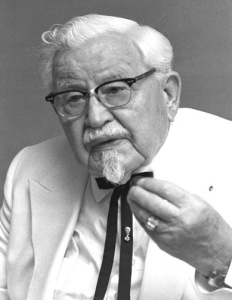
Harland David Sanders was born September 9, 1890, in a four-room house near Henryville, Indiana. His father died when Harland was five, and his mother went to work at a canning plant, leaving Harland, as the eldest son, responsible for looking after his two younger siblings. His mother taught him to cook once he turned seven, and by his own later account he was making full family meals not long after.
Sanders left home at thirteen and spent the following decades cycling through an unusually wide range of jobs: farmhand, streetcar conductor, steam engine stoker, insurance salesman, and filling station operator among them.
None of that early work pointed toward the restaurant business, and Sanders himself later described his path into cooking as something closer to a fallback than a calling, a trade he happened to know something about when other options ran out.
A Service Station in Corbin
In 1930, Sanders took over a Shell filling station on U.S. Route 25 just outside North Corbin, Kentucky, a small town on the edge of the Appalachian foothills. He began serving the fried chicken and country cooking he had learned as a child to travelers passing through, and the food quickly overtook gasoline as the reason people stopped. Five years later, in 1935, the governor of Kentucky granted Sanders an honorary Kentucky Colonel title in recognition of his contributions to the state’s cuisine, the origin of the “Colonel” persona that would define the rest of his public life.
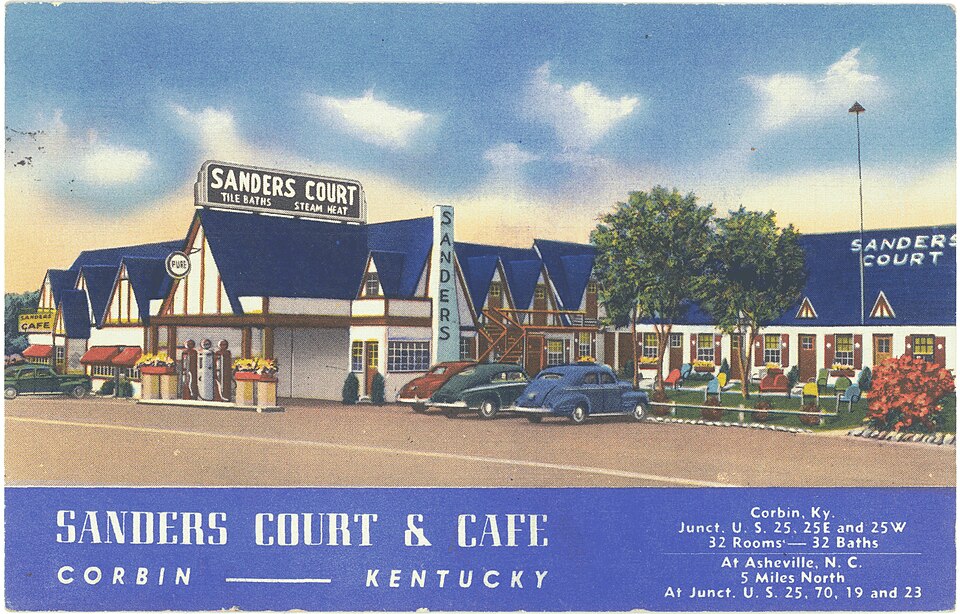
By 1939 Sanders had refined his approach into something distinctive: a blend of eleven herbs and spices cooked in a pressure fryer, a method that cut cooking time dramatically compared to pan-frying while sealing in moisture the older method tended to cook out. He expanded the operation into Sanders Court and Café, a combined restaurant and motor court that became a well-known stop for Depression-era and, later, wartime travelers moving along the highway corridor through central Kentucky.
I wanted to be called Kentucky Fried Chicken, because it wasn’t Southern Fried. Kentucky is a wonderful name anyway.
— Colonel Harland Sanders
From One Diner to a Nationwide Franchise
Sanders’s Corbin business was thriving by the early 1950s, but a new interstate highway routed traffic away from his location almost overnight, gutting the customer base that had sustained Sanders Court and Café for two decades. He sold the property at auction, netting barely enough to cover his outstanding taxes and bills, a collapse that would have ended most careers of that era for a man already in his sixties.
Instead, at 65, Sanders decided the recipe itself, not the restaurant, was the asset worth building on. Living for a stretch on his monthly Social Security check and sleeping in the back of his car between sales calls to save money for pressure cookers, he began driving from restaurant to restaurant offering to license his chicken recipe and cooking method in exchange for a nickel per chicken sold. The first franchise opened in South Salt Lake, Utah, in 1952 through a partnership with restaurateur Pete Harman, and Sanders formally began “franchising in earnest,” in his own words, at age 66.
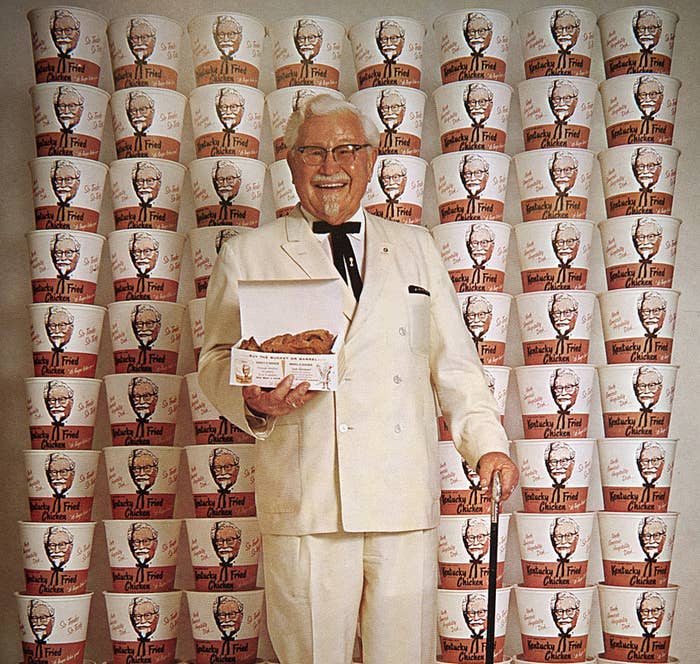
The nickel-per-chicken royalty arrangement grew slowly at first, but within a couple of years it had scaled into a steady income stream, and within a decade Kentucky Fried Chicken had become a recognizable name well beyond Kentucky. What began as a single roadside operation salvaged from bankruptcy turned into one of the first and most successful fast food franchise systems in American history.
Selling the Company, Keeping the Persona
By 1964, at 73, Sanders sold Kentucky Fried Chicken to a group of investors led by John Y. Brown Jr. and Jack C. Massey for roughly $2 million. He remained with the company afterward as its public face and brand ambassador rather than stepping away entirely, traveling extensively to promote the chain and appearing in its advertising well into his eighties. The white suit, black string tie, and goatee that had started as a regional Kentucky Colonel affectation became, through those years of constant public appearances, one of the most recognized commercial trademarks in the world.
Sanders was notoriously blunt about the company’s direction even after selling it, publicly criticizing changes to the recipe and preparation methods he felt cheapened the product he had spent decades perfecting. That willingness to criticize his own former company, even as its most visible spokesman, became almost as much a part of his public persona as the white suit itself.
Louisville’s Colonel
Sanders spent his later years based in the Louisville area, and much of the fortune from the 1964 sale went toward philanthropy rather than personal use. He gave away a Canadian KFC franchise operation worth several million dollars to charity and used other proceeds to fund scholarships for students at colleges across the country, support that by his own account eventually reached roughly a thousand students at any given time.
Sanders died December 16, 1980, in Louisville, of complications from leukemia and pneumonia at age 90, and was buried at Cave Hill Cemetery, the same historic Louisville burial ground that holds a number of the city’s other notable historical figures. He had continued traveling and making public appearances almost until the end of his life, a work pace he attributed simply to having the health and ability to keep going.
More than four decades after his death, the Colonel Sanders image remains one of the most widely recognized commercial figures in the world, an unusual legacy for a man who did not find real financial success until an age when most people are winding a career down rather than starting one over. Louisville, where he spent his final years and where he is buried, has continued to claim him as one of its own, a hometown symbol of the particular kind of late-blooming, roadside-diner entrepreneurship that turned a single Corbin filling station into a global fast food chain.
Sanders’s own account of his career rarely dwelled on the setbacks, the failed jobs, the bankrupt cafe, the highway bypass, as tragedies. He tended to describe each one instead as a problem to be solved with whatever he had left, an attitude that carried him from a Depression-era filling station to a fortune he spent much of his later life giving away.
Sources and further reading
- Early life, Corbin years, and franchise history — Wikipedia, Britannica, and the Rosenberg International Franchise Center
- Recipe and pressure-frying method — KFC’s official company history and Smithsonian Magazine
- Sale of the company and later philanthropy — Encyclopedia.com and Smithsonian Magazine
- The Real Colonel Sanders Hated Everything that KFC Became — Food & Wine Magazine
- Quotes — QuotesWise
- Death and burial — Wikipedia and Cave Hill Cemetery records